Drosera stolonifera Endl.
Species sheet, updated on 30/10/2026.
At a glance
| Scientific name | Drosera stolonifera Stephan Endlicher, Enumeratio plantarum, 1837 |
| Family | Droseraceae (subgenus Ergaleium, section Stolonifera) |
| Distribution | Swamps around Perth down to Pinjarra (Western Australia) |
| Habitat | Waterlogged peaty soils of swampy heathland; clayey sands in jarrah forest |
| Status | Least concern (LC) on the IUCN Red List |
Photos in the wild
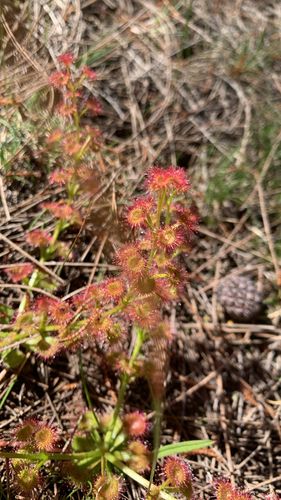
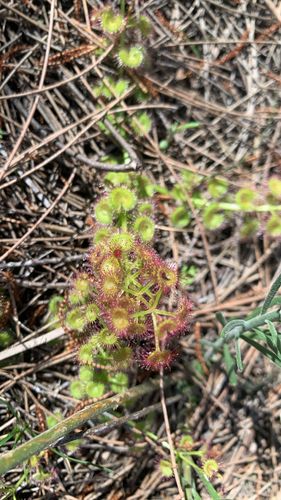
Etymology
- Drosera: see the genus sheet.
- stolonifera: from the Latin, “bearing stolons”. In English: “leafy sundew”.
History of the description
- 1833: Charles von Hügel collects the type specimens in the Swan River region.
- Long seen as a group of forms, it has been split into several species: D. purpurascens, D. humilis, D. rupicola, D. porrecta, D. prostrata and D. monticola.
Description (how to recognise it)
- Perennial tuberous plant with 2 or 3 side stems, half upright, 10 to 15 cm long.
- The hill form turns red as it ages.
- Flowers from September to October, en masse after fires.
Distribution
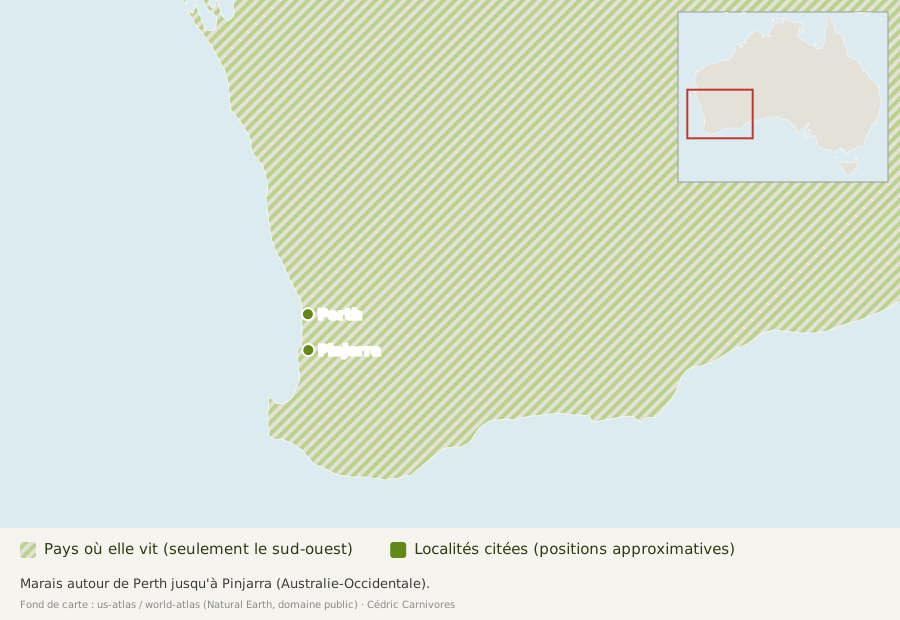
Endemic to Western Australia: swamps around Perth and south as far as Pinjarra.
Habitat
Waterlogged peaty soils of swampy heathland; the hill form grows on well-drained clayey sands in jarrah forest.
Did you know?
- Its closest relative is D. purpurascens.
Sources
- Wikipedia (English), Drosera stolonifera: author, common name, history, separated species, description, flowering, range, habitat, relationships, section.
- GBIF, Drosera stolonifera: author, original publication, IUCN Red List category, countries and localities of herbarium specimens and observations.