Drosera stricticaulis (Diels) O. H. Sarg.
Species sheet, updated on 30/10/2026.
At a glance
| Scientific name | Drosera stricticaulis Ludwig Diels (1906, as a variety); Oswald Hewlett Sargent, 1913 |
| Synonyms | D. macrantha var. stricticaulis Diels |
| Family | Droseraceae (subgenus Ergaleium, section Ergaleium: upright or climbing tuberous sundews) |
| Distribution | Western Australia and South Australia (Eyre Peninsula, Dutchmans Stern) |
| Habitat | Near watercourses and granite, on sandy clay or loam |
| Status | Least concern (LC) on the IUCN Red List |
Photos in the wild
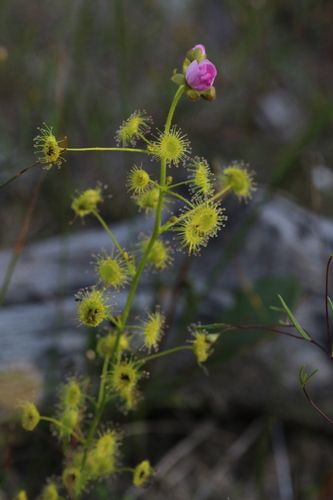
Etymology
- Drosera: see the genus sheet.
- stricticaulis: from the Latin, “with a stiff stem”. In English: “erect sundew”.
History of the description
- 1906: Diels describes it as a variety of D. macrantha.
- 1913: Sargent raises it to species rank.
- 1996: Jan Schlauer includes D. macrantha subsp. eremaea (1992) in it; FloraBase keeps it under D. macrantha.
Description (how to recognise it)
- Perennial tuberous plant, upright, up to 25 cm, with green glandular stems.
- Small cup-shaped trap leaves.
- Pink flowers, from July to October.
Distribution
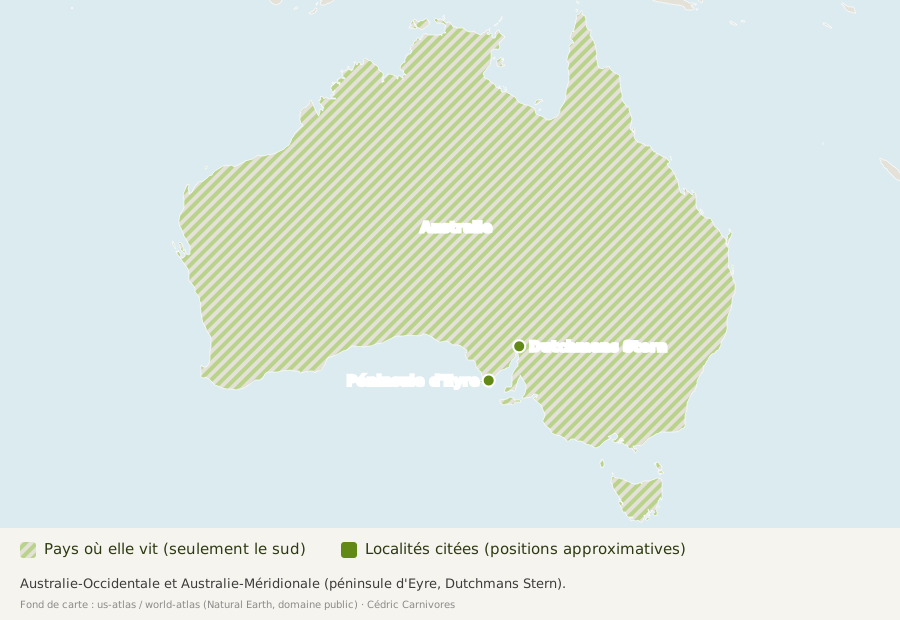
Western Australia and South Australia, mainly the southern Eyre Peninsula and Dutchmans Stern (southern Flinders Ranges).
Habitat
Near watercourses and granite outcrops, on sandy clay or loam. According to the collections and observations published in GBIF, it grows mainly from 20 to 537 m above sea level.
Sources
- Wikipedia (English), Drosera stricticaulis: authors, synonym, common name, history, description, flowering, range, habitat, section.
- GBIF, Drosera stricticaulis: author, original publication, IUCN Red List category, countries, altitude and localities of herbarium specimens and observations.