Drosera ultramafica A. Fleischm., A. S. Rob. & S. McPherson
Species sheet, updated on 30/10/2026.
At a glance
| Scientific name | Drosera ultramafica Andreas Fleischmann, Alastair Robinson & Stewart McPherson, Blumea, 2011 |
| Family | Droseraceae |
| Distribution | Highlands of Malesia, including Mount Victoria (Palawan, Philippines) |
| Habitat | Uplands on ultramafic rocks |
| Status | Not yet assessed by the IUCN |
Photos in the wild
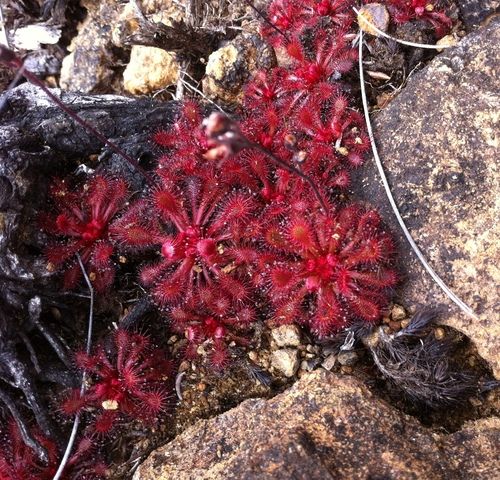
Etymology
- Drosera: see the genus sheet.
- ultramafica: after the ultramafic rocks on which it grows. In English: “ultramafic-growing sundew”.
Description (how to recognise it)
- Rosette that differs in shape from those of its closest relatives.
- According to Fleischmann et al. (2011), who described it: a perennial rosette sundew, forming with age a short stem up to 5 cm; leaves narrow, oblanceolate to oblong, half upright, green to dark red, 2 to 4 cm long; the plant thus takes on an almost ball-shaped look, very different from the ground-hugging rosettes of D. spatulata.
- 1 to 4 scapes up to 20 cm, with 4 to 15 flowers; petals white on Palawan and Sulawesi, pink in northern Sumatra, both colours being reported on Kinabalu.
Distribution
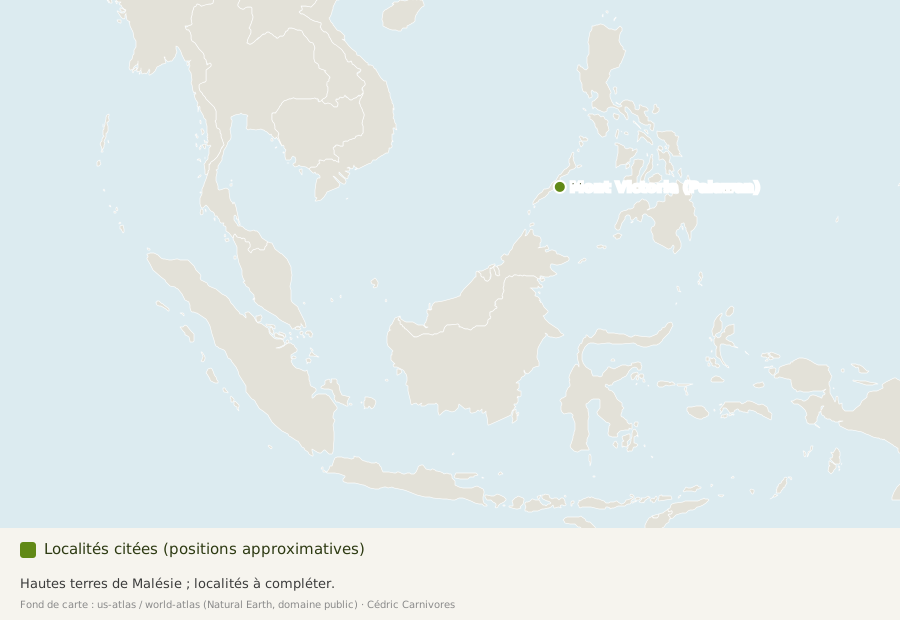
Highlands of Malesia, for example Mount Victoria on Palawan. Regions where most of the herbarium specimens and observations published in GBIF come from (number of records): Sumatra (11), Sabah (6). According to Kew's world list of plants (WCVP), it is native to the following regions: Borneo, the Philippines, Sulawesi and Sumatra.
Habitat
Uplands on ultramafic rocks. Fleischmann et al. (2011) record it in upper montane forest on ultramafic soils, from 1 500 to 3 000 m: on Palawan at about 1 600 to 1 700 m in seepages on very free-draining rocky soil, on Mount Mantalingahan in full sun among grasses, on Mount Victoria among grasses and ultramafic boulders, notably with Nepenthes attenboroughii; also on Kinabalu (Marai Parai) and in northern Sumatra. In flower and fruit in July–August. According to the collections and observations published in GBIF, it grows mainly at about 1 524 m above sea level.
Did you know?
- Its closest relatives are thought to be D. spatulata, D. neocaledonica and D. oblanceolata, whose ranges do not touch its own.
Sources
- Wikipedia (English), Drosera ultramafica: authors, publication, range, habitat, relationships.
- Kew, World Checklist of Vascular Plants (via GBIF): natural distribution.
- Fleischmann et al., Blumea 56, 2011 (archive.org): original description, ecology, localities.
- GBIF, Drosera ultramafica: author, original publication, countries, altitude and localities of herbarium specimens and observations.