Drosera viridis Rivadavia
Species sheet, updated on 30/10/2026.
At a glance
| Scientific name | Drosera viridis Fernando Rivadavia, Carnivorous Plant Newsletter, 2003 |
| Family | Droseraceae (subgenus and section Drosera) |
| Distribution | Eastern Paraná, São Paulo and central Santa Catarina (Brazil) |
| Habitat | Waterlogged places among grasses, from 550 to 1 100 m |
| Status | Not yet assessed by the IUCN |
Photos in the wild
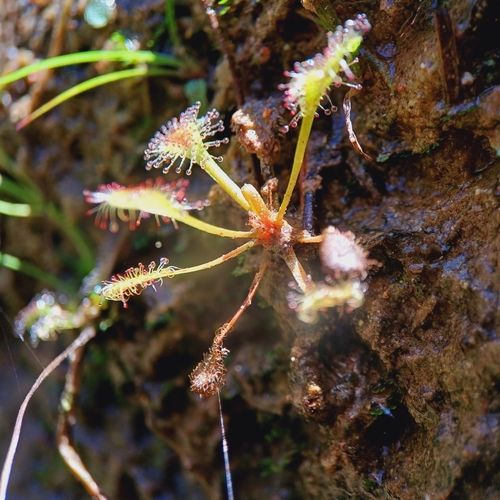
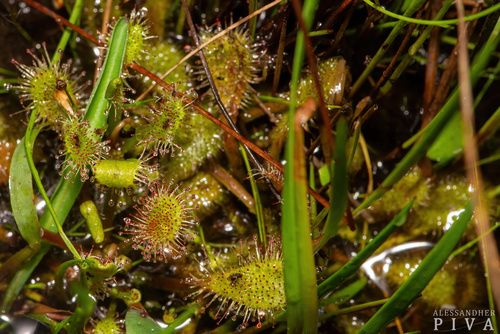
Etymology
- Drosera: see the genus sheet.
- viridis: from the Latin, “green”: its leaves stay entirely green, even in full sun.
History of the description
- 2 February 1996: Rivadavia and M. R. F. Cardoso collect the type specimen.
- 2003: described along with three other new Brazilian sundews.
Description (how to recognise it)
- Perennial plant, half upright or forming a rosette, with spatulate leaves 5 to 28 mm long.
- 1 to 3 scapes 7.5 to 30 cm tall bearing 2 to 12 light to dark lilac flowers.
- Flowers all year round, mainly in the rainy season (December to March).
Distribution
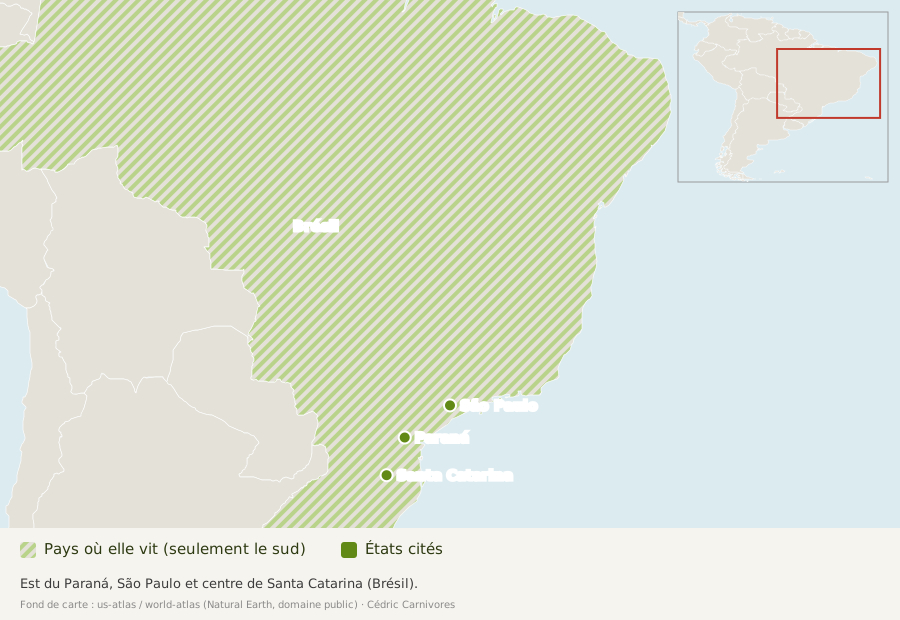
Endemic to Brazil: eastern Paraná, São Paulo and central Santa Catarina; perhaps also in Argentina, Paraguay and Uruguay.
Habitat
Waterlogged places among grasses, on white clay, reddish laterite or black humus-rich soil, from 550 to 1 100 m; sometimes submerged, with only the leaves sticking out of the water.
Natural hybrids
Rare weak hybrids, probably sterile, with D. communis, its close relative, which often shares its habitat.
Sources
- Wikipedia (English), Drosera viridis: author, etymology, type specimen, description, flowering, range, altitude, habitat, hybrids, section.
- GBIF, Drosera viridis: author, original publication, countries and localities of herbarium specimens and observations.