Genlisea africana Oliv.
Species sheet, updated on 30/10/2026.
At a glance
| Scientific name | Genlisea africana Daniel Oliver, J. Linn. Soc., Bot. 9: 145, 1865 |
| Family | Lentibulariaceae (section Africanae) |
| Distribution | From Guinea to Liberia, and from western Tanzania to southern tropical Africa. |
Photos in the wild
Etymology
- Genlisea: see the genus sheet.
- africana: “from Africa”.
Description (how to recognise it)
- According to Stapf (1906): numerous spatula-shaped leaves, 4 to 6 mm, on a petiole 4 to 10 mm long; underground traps very variable in size, with a tube 6 to 15 mm long.
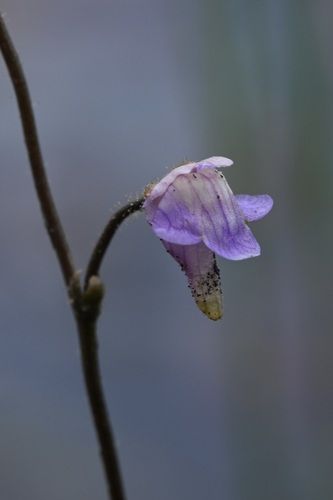
- Upright scape up to more than 30 cm, covered with glandular hairs; 3 to 6 pale mauve flowers (blue when dried) about 8.5 mm, with a 3-lobed lower lip and a cylindrical spur.
Distribution
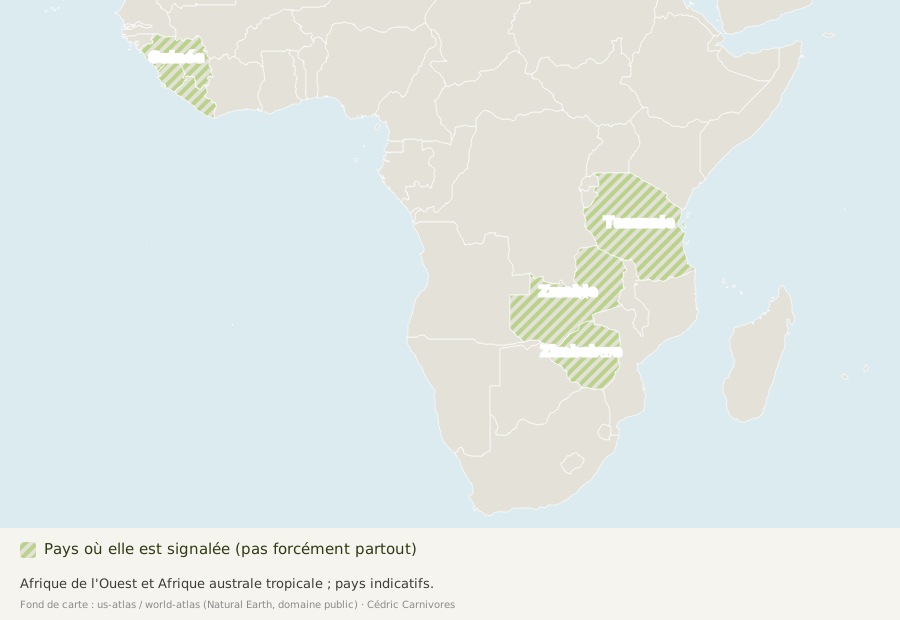
From Guinea to Liberia, and from western Tanzania to southern tropical Africa. According to Kew's world list of plants (WCVP), it is native to the following regions: Angola, DR Congo, Guinea, Liberia, Sierra Leone, Tanzania, Zambia and Zimbabwe.
Habitat
Stapf (1906) cites collections from marshy places on the banks of the Lopollo River, at about 1 500 to 1 600 m (Huíla, Angola), at Humpata, in the Chela Mountains and near the Cunene; then, in the addendum, on Livingstone Island and in the rainforest at Victoria Falls.
Did you know?
- It was in its traps that John Heslop-Harrison showed in 1975 that Genlisea produce digestive enzymes, long before the full proof of their carnivory in 1998.
Sources
- Wikipedia (German), Genlisea: section, range.
- Wikipedia (English), Genlisea africana: author, status.
- Carnivorous Plant FAQ (Barry Rice), the genus Genlisea: enzymes, 1975.
- Kew, World Checklist of Vascular Plants (via GBIF): natural distribution.
- Stapf, Flora of Tropical Africa IV.2: Lentibulariaceae, 1906 (archive.org): description, localities and habitats of the specimens (translated from English).