Genlisea aurea A. St.-Hil.
Species sheet, updated on 30/10/2026.
At a glance
| Scientific name | Genlisea aurea Auguste de Saint-Hilaire, 1833 |
| Family | Lentibulariaceae (subgenus and section Genlisea) |
| Distribution | Brazil: from Mato Grosso to north-eastern Bahia and Santa Catarina |
| Habitat | Waterlogged seepages on high sandstone plateaus, among grasses, from 550 to 2 550 m |
Photos in the wild
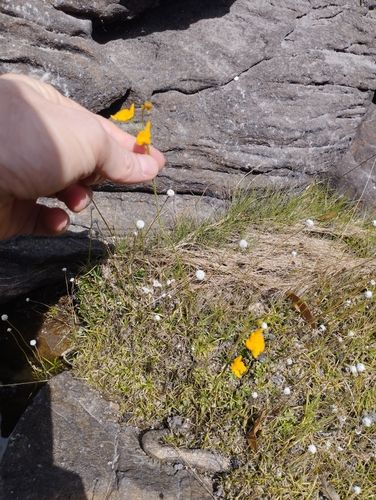
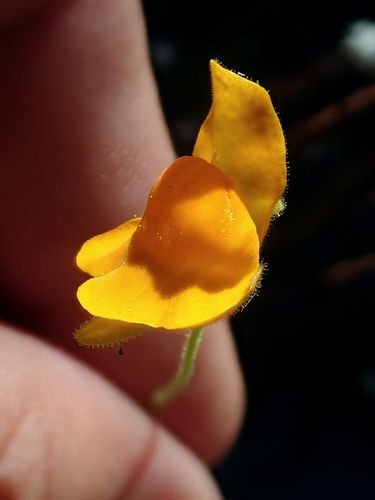
Etymology
- Genlisea: see the genus sheet.
- aurea: from the Latin, “golden”, for its yellow flowers.
History
One of the first four Genlisea described by Saint-Hilaire in 1833. Darwin mentions it in 1875; Barthlott proves its carnivory in 1998.
Description (how to recognise it)
- Small rosettes; the trap leaves are underground, with no true roots.
- A scape up to about 40 cm, with up to 11 yellow flowers 1.5 to 2 cm across, the largest of the yellow-flowered species. It can flower all year round.
- Two varieties: var. aurea and var. minor.
A tiny genome
About 63.6 million base pairs for about 52 chromosomes: its chromatids are smaller than the chromosome of an E. coli bacterium.
Distribution
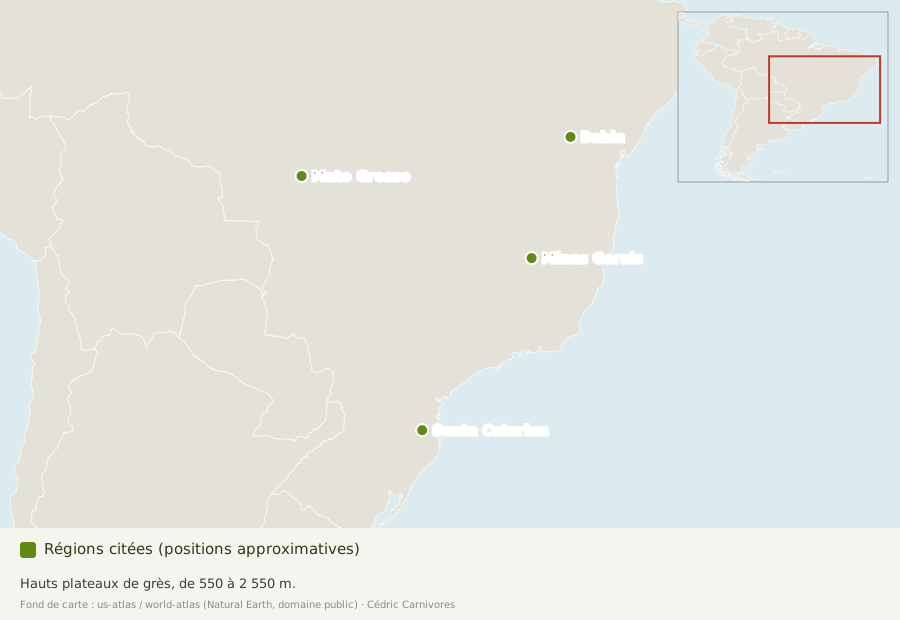
Endemic to Brazil, from Mato Grosso in the west to north-eastern Bahia and Santa Catarina in the south-east, from 550 to 2 550 m.
Habitat
High sandstone plateaus: black, humus-rich soil (sometimes sandy), among grasses, in waterlogged seepages.
Sources
- Wikipedia (English), Genlisea aurea: Saint-Hilaire 1833, description, flowers, range, altitude, habitat, genome, Darwin, Barthlott 1998.
- List of small genera: varieties.