Genlisea hawkingii S. R. Silva, Płachno, S. G. M. Carvalho & Miranda
Species sheet, updated on 30/10/2026.
At a glance
| Scientific name | Genlisea hawkingii Saura R. Silva, Bartosz J. Płachno, Samanta G. M. Carvalho and Vitor F. O. Miranda, PLOS ONE, 2020 |
| Family | Lentibulariaceae (subgenus Tayloria) |
| Distribution | Serra da Canastra, municipality of Delfinópolis (Minas Gerais), from 1 080 to 1 140 m. |
| Habitat | Cerrado, among rocks on shallow sandy soils, near streams and waterfalls |
| Status | Data deficient (IUCN); a single population of about 80 plants |
Etymology
- Genlisea: see the genus sheet.
- hawkingii: in honour of the physicist and cosmologist Stephen Hawking, who died in March 2018.
Description (how to recognise it)
- Small annual plant up to 30 cm, forming a loose rosette of about twenty green spatulate leaves, up to 12 mm long.
- Pale lavender to lilac flowers 7 to 10 mm across, with two yellow ridges forming a round spot at the base of the lower lip, and often violet streaks on the upper lip.
- Conical spur, curved at the tip, longer than the lower lip.
- Mass flowering and fruiting from March to May.
Distribution
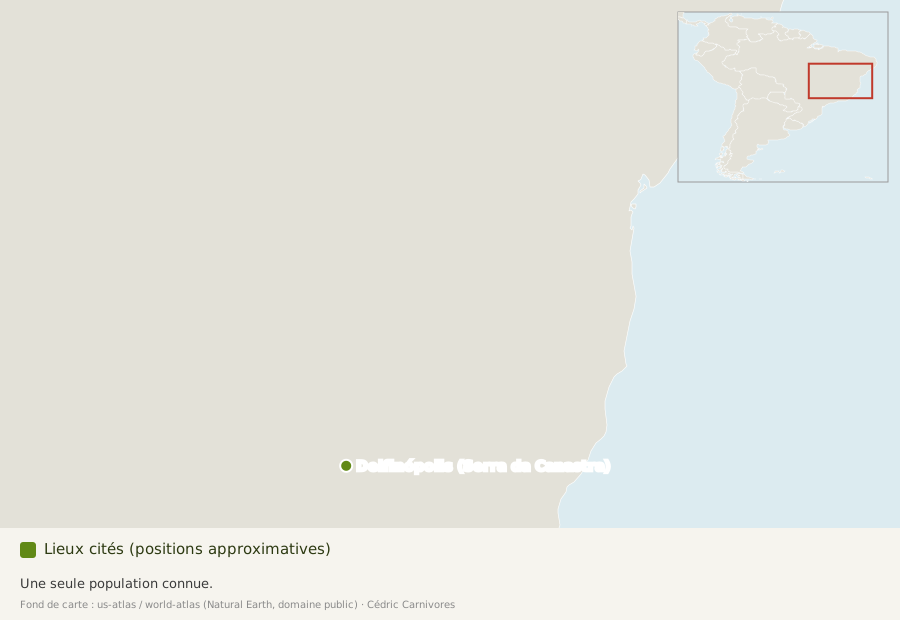
Serra da Canastra, municipality of Delfinópolis (Minas Gerais), from 1 080 to 1 140 m.
Habitat
Cerrado: among rocks, on shallow sandy soils, often near streams and waterfalls, with grasses, sedges, shrubs and bladderworts, but with no other Genlisea.
Relationships
The oldest lineage of subgenus Tayloria, sister to all the others; next comes G. uncinata, which also has a curved spur. The authors think this curved spur may be linked to different pollinators.
Threats
The only known population covers about 90 m², on a farm near the boundary of the Serra da Canastra National Park: it suffers from trampling by cattle and horses. The region is little explored and other populations may exist.
Sources
- Silva et al., “Genlisea hawkingii, a new species from Serra da Canastra”, PLOS ONE, 2020: all the content of this sheet.