Genlisea subglabra Stapf
Species sheet, updated on 30/10/2026.
At a glance
| Scientific name | Genlisea subglabra Otto Stapf |
| Synonyms | G. taylorii |
| Family | Lentibulariaceae (section Africanae) |
| Distribution | From Burundi to southern Tanzania and eastern Angola. |
Etymology
- Genlisea: see the genus sheet.
- subglabra: from the Latin, “almost glabrous”.
Description (how to recognise it)
- According to Stapf (1906), who described it: leaves fairly numerous, wedge-shaped obovate, 8 to 13 mm long and at most 6 mm wide, on a thin petiole up to 13 mm; upright, thread-like scape, glabrous (hence its name), bearing 3 to 5 well-spaced flowers.
- Corolla about 7 mm, dark blue (when dried) with a yellow palate; lower lip in 3 lobes; ovary glabrous. Stapf considers it very close to G. africana, from which it differs by its much larger leaves and a glabrous or almost glabrous inflorescence.
Distribution
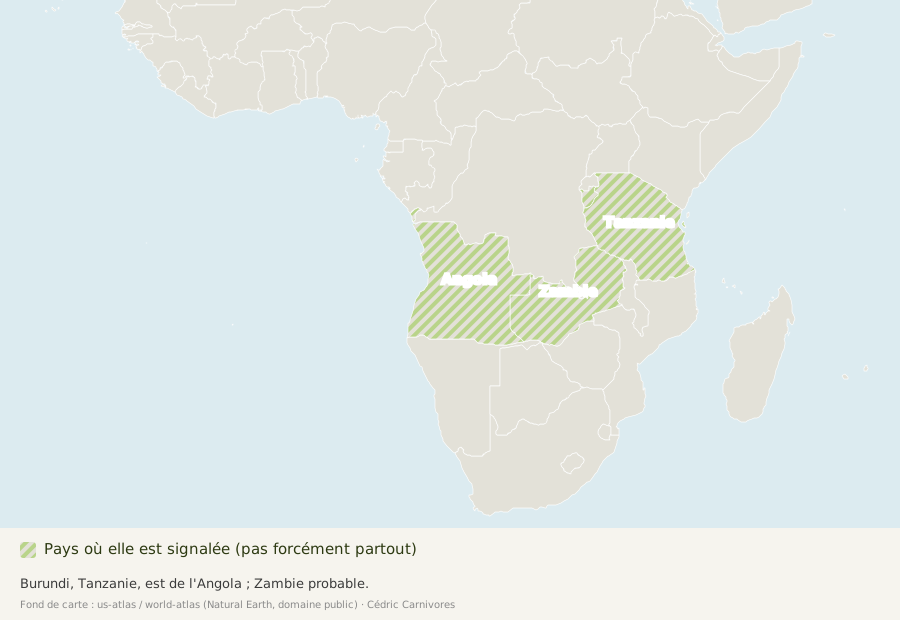
From Burundi to southern Tanzania and eastern Angola. According to Kew's world checklist of plants (WCVP), it is native to the following regions: Angola, Burundi, DR Congo, Malawi, Tanzania and Zambia.
Habitat
Stapf (1906) cites two collections by Nutt, southwest of Lake Tanganyika: Jambole, at about 1 500 m, and Fwambo (Urungu), at about 1 600 m.
Sources
- Wikipedia (German), Genlisea: section, range.
- Kew, World Checklist of Vascular Plants (via GBIF): natural distribution.
- Stapf, Flora of Tropical Africa IV.2: Lentibulariaceae, 1906 (archive.org): description and localities (original English text).