Nepenthes abgracilis Jebb & Cheek
Species sheet, updated on 30/10/2026.
At a glance
| Scientific name | Nepenthes abgracilis Matthew Jebb & Martin Cheek, Phytotaxa 151, 2013 |
| Family | Nepenthaceae |
| Distribution | Former province of Surigao, north-eastern Mindanao (Philippines) |
| Habitat | Forested ridges at mid-mountain altitude, probably on ultramafic rocks, around 670 m |
| Status | Critically endangered according to Cheek & Jebb (informal assessment) |
Etymology
- Nepenthes: see the genus sheet.
- abgracilis: “coming from gracilis”: Elmer Merrill had first taken a specimen for N. gracilis.
History of the description
- April 1919: Ramos and Pascasio collect the type specimen in the former province of Surigao, at around 670 m.
- 2008-2009: photos of a similar plant appear in Das Taublatt and in Stewart McPherson's book, under the name “form of N. alata”.
- 2013: description, in the paper that creates the N. micramphora group and also describes N. cid.
Description (how to recognise it)
- A climbing plant several metres long, hairless, with a round, wingless stem.
- Leathery leaves without a petiole, up to 29 cm by 3.
- Almost cylindrical upper pitchers, about 16 cm by 5.5, yellow-green with a red peristome; underside of the lid tinged or speckled with red; simple spur.
- The lower pitchers and the flowers remain unknown.
Distribution
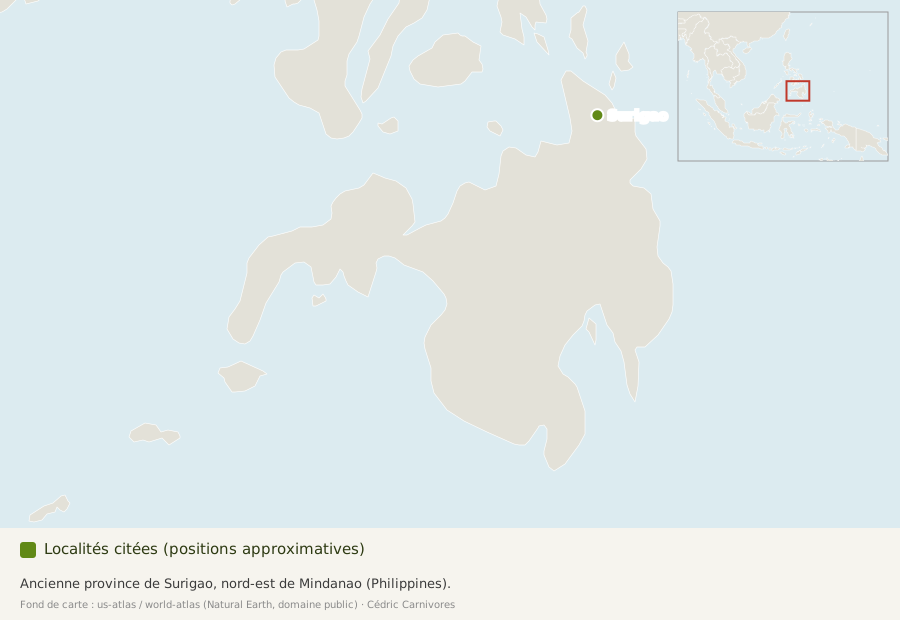
Endemic to Mindanao: known with certainty only from the former province of Surigao (north-east), and also reported on Mount Legaspi.
Habitat
Forested ridges at mid-mountain altitude, probably on ultramafic rocks; a terrestrial plant.
Threats and protection
Cheek and Jebb consider it critically endangered: metal mines are worked on Mount Legaspi.
Did you know?
- It differs from N. micramphora by its much larger cylindrical pitchers (16 cm against 7 at most), and from N. cid because it is terrestrial, hairless and without a petiole.
Sources
- Wikipedia (English), Nepenthes abgracilis: publication, type specimen, etymology, description, range, habitat, threats, relationships.