Nepenthes adnata Tamin & M. Hotta ex Schlauer
Species sheet, updated on 29/10/2026.
At a glance
| Scientific name | Nepenthes adnata Tamin & M. Hotta ex Jan Schlauer, 1994 |
| Family | Nepenthaceae |
| Distribution | Tjampo river area, West Sumatra |
| Habitat | Damp, mossy sandstone cliffs under dense vegetation, from 600 to 1,200 m |
| Status | Endangered (IUCN) |
Etymology
- Nepenthes: see the genus sheet.
- adnata: from the Latin adnatus, “broadly fused”, for the leaf base attached to the stem.
History of the description
- 24 August 1957: Willem Meijer collects it, on the same day as N. tenuis (Leiden herbarium).
- 1986: Tamin and Hotta describe it, but without a Latin diagnosis: the name is not valid.
- 1994: Jan Schlauer adds the diagnosis and validates the name.
Description (how to recognise it)
- A small plant with a thin stem, rarely more than 2 m.
- Leaves: without a petiole, up to 10 cm.
- Pitchers: small, up to about 10 cm; rounded at the bottom, cylindrical at the top; usually spotted with purple-red, with a dark purple peristome, white to light green inside.
- It varies little: no variety has been described.
Distribution
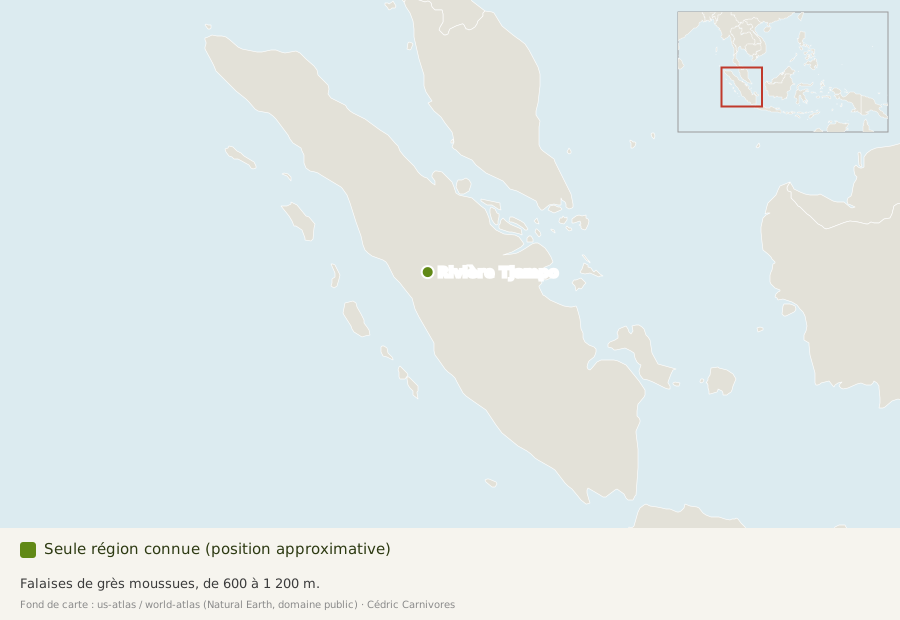
Endemic to the Tjampo river area, in West Sumatra, from 600 to 1,200 m.
Habitat
Damp, mossy sandstone cliffs, under dense vegetation, in diffuse light. It grows near N. tenuis, N. albomarginata, N. ampullaria and others.
Relationships
Its relationship with N. tentaculata is debated; for Clarke, their similarities are probably due to chance.
Natural hybrids
None known.
Threats and protection
- “Endangered” for the IUCN. Only two collections of it exist.
- The easily accessible population is very small and heavily plundered: Clarke calls it “seriously threatened”. Agricultural fires are another danger.
Sources
- Wikipedia (English), Nepenthes adnata: Meijer 1957, Tamin & Hotta 1986, Schlauer 1994, etymology, description, range, altitude, habitat, relationships, status, threats.