Nepenthes ampullaria Jack
Species sheet, updated on 29/10/2026.
At a glance
| Scientific name | Nepenthes ampullaria William Jack, 1835 |
| Family | Nepenthaceae |
| Common names | Flask-shaped pitcher-plant; in French népenthès en flacon |
| Distribution | Borneo, Sumatra, Malay Peninsula, Singapore, Thailand, Moluccas, New Guinea |
| Habitat | Damp, shady forests, from sea level to about 2,100 m |
| Status | Least concern (IUCN) |
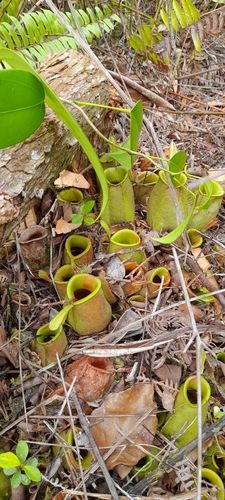
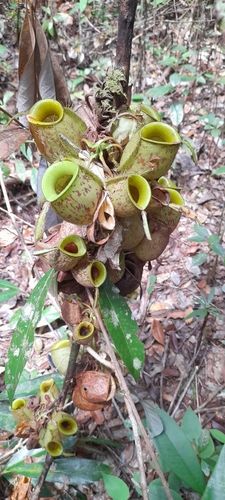
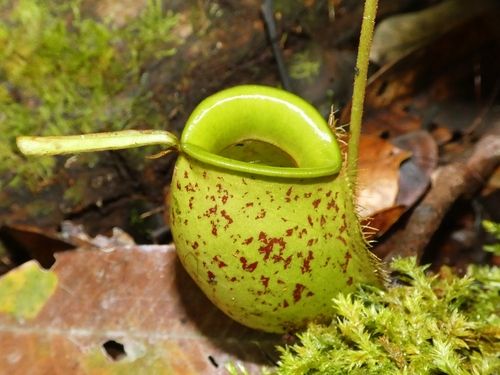
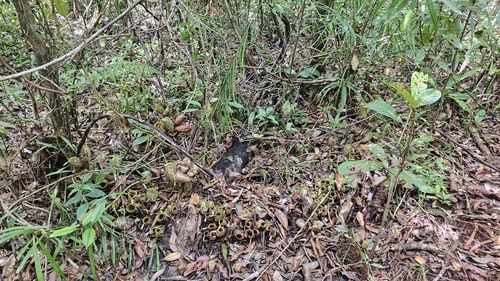
Photos in the wild
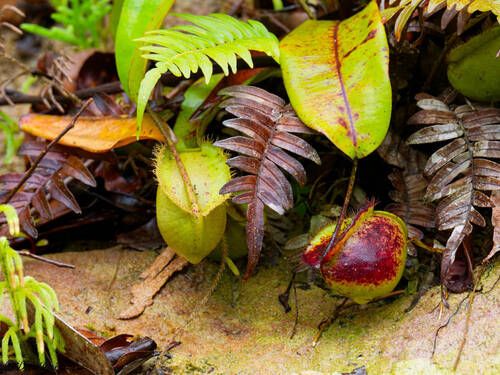
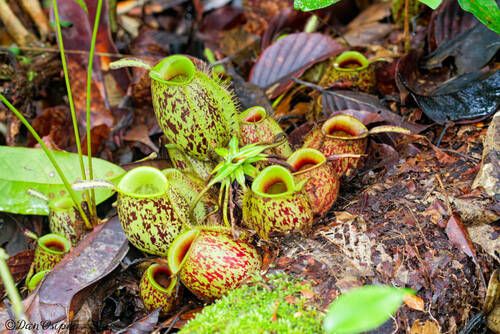
Etymology
- Nepenthes: see the genus sheet.
- ampullaria: from the Latin ampulla, “flask, vial”, for the shape of its pitchers.
Description (how to recognise it)
- A climber with light brown stems, up to about 15 m.
- Carpets of pitchers: on the ground it forms carpets of small, bulbous pitchers, rarely more than 10 cm, growing in rosettes.
- A strongly inrolled peristome and a small lid bent backwards, which does not protect the pitcher from rain.
- Colours: from light green to dark red, depending on the region.
- Upper pitchers: rare and small.
Distribution
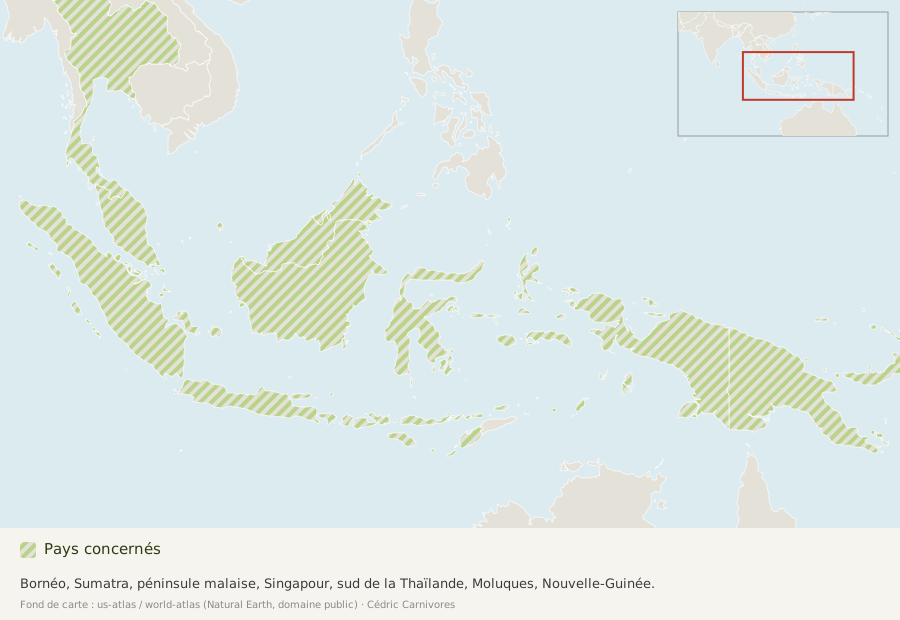
Borneo, the Moluccas, New Guinea, the Malay Peninsula, Singapore, Sumatra and Thailand, as well as many small islands.
Habitat
Damp, shady forests, from sea level to about 2,100 m:
- in Borneo: kerangas (heath forests), peat swamp forests, degraded swamp forests;
- in Sumatra and the Malay Peninsula: heath forests, padang (open heaths), belukar (secondary forests), peat forests and even rice fields;
- in New Guinea: mainly in Araucaria forests.
Ecology: an eater of dead leaves
- A “detritivorous” plant: it gets a good part of its food from the dead leaves that fall into its pitchers, and not mainly from live prey. Its bent-back lid, its reduced glands and the almost complete absence of a waxy zone all point that way.
- An apartment block: its pitchers shelter at least 59 species of animals, including a tiny frog, Microhyla nepenthicola, and a crab spider, Henriksenia nepenthicola, which are named after it.
Natural hybrids
It hybridises easily with the species that flower at the same time as it does:
| Hybrid | Other parent |
|---|---|
| N. × hookeriana | N. rafflesiana |
| N. × kuchingensis | N. mirabilis |
| N. × trichocarpa | N. gracilis |
| unnamed | N. albomarginata, N. bicalcarata, N. eustachya, N. hemsleyana, N. hirsuta, N. neoguineensis, N. reinwardtiana, N. spathulata, N. tobaica |
Threats and protection
“Least concern” for the IUCN.
Did you know?
- It feeds partly on dead leaves, like a compost heap.
- A tiny frog lays its eggs in its pitchers.
Sources
- Wikipedia (English), Nepenthes ampullaria: Jack 1835, etymology, description, range, habitats, altitude, detritivory, 59 species of inhabitants, hybrids, status; reference: Phillipps & Lamb 1996, Pitcher-Plants of Borneo.