Nepenthes aristolochioides Jebb & Cheek
Species sheet, updated on 29/10/2026.
At a glance
| Scientific name | Nepenthes aristolochioides Matthew Jebb & Martin Cheek, Blumea, 1997 |
| Family | Nepenthaceae |
| Distribution | Mount Tujuh and Mount Kerinci, Kerinci Seblat National Park (Sumatra) |
| Habitat | Mossy forest with sphagnum near the ridges, from 1,800 to 2,500 m |
| Status | Critically endangered (IUCN, 2013) |
Etymology
- Nepenthes: see the genus sheet.
- aristolochioides: “resembling an Aristolochia”, from the name of these climbing plants with pipe-shaped flowers, and the Latin suffix -oides. Its pitchers have their shape and colours.
History of the discovery
- 5 August 1956: the botanist Willem Meijer collects it on Mount Tujuh (Jambi), at around 2,000 m, with the note “new species?”. The specimen, in poor condition, lies for more than 30 years in the Leiden herbarium.
- 1988: Joachim Nerz notices it.
- 1994: Jan Schlauer wonders whether the vertical mouth is not a drying defect, as the pitcher had been crushed.
- June 1996: Nerz and Katrin Hinderhofer find it again in the wild: the vertical mouth was indeed real.
- 1997: Jebb and Cheek describe it; Nerz publishes a detailed description of it in 1998.
Description (how to recognise it)
- A climber up to 8 m.
- Upper pitchers: up to 15 cm, narrow at the bottom, swollen at the top, with a marked dome and an almost vertical mouth, unique in the genus. The peristome forms an entrance corridor, like a lobster pot.
- Windows: the dome bears translucent patches that let the light through.
- Lower pitchers: up to 7 cm, often buried in the sphagnum.
- No waxy zone.
- Colours: pitchers white to reddish, speckled with red-brown to purple; peristome dark red or purple; inside white to light yellow.
Distribution
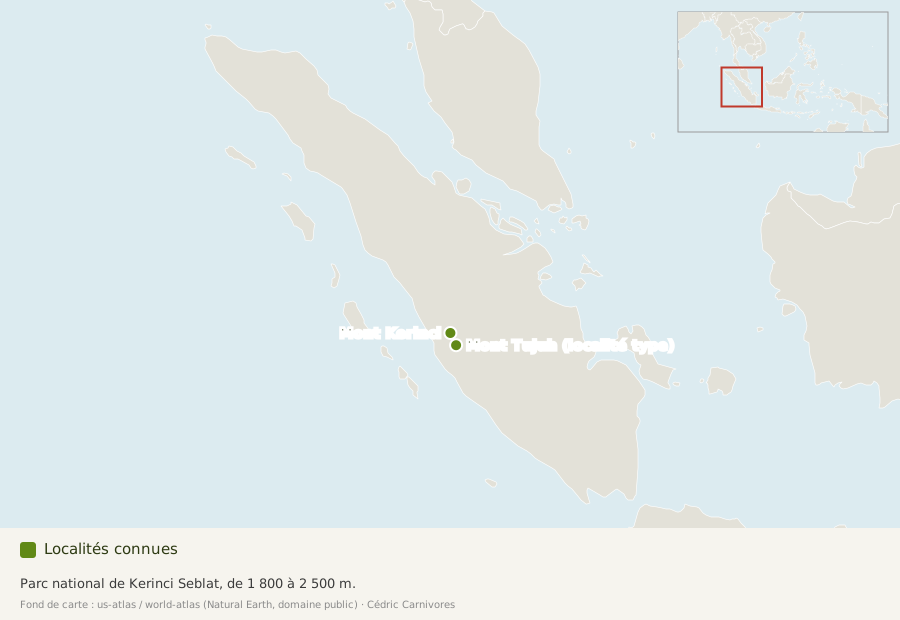
Endemic to Sumatra: Mount Tujuh and Mount Kerinci, with three subpopulations in Kerinci Seblat National Park (McPherson, 2009). From 1,800 to 2,500 m.
Habitat
- Mossy forest dominated by sphagnum, near steep ridges;
- usually on the ground, sometimes in the moss on tree trunks;
- with N. gymnamphora and N. singalana: a small form of N. singalana stays on the ground, while N. aristolochioides climbs into the canopy.
Ecology: a light trap
- Lower pitchers: pitfall traps for walking insects.
- Upper pitchers: light traps. The light coming through the windows attracts small flies, which get lost inside and drown. As in Darlingtonia californica or Sarracenia minor. Together with N. klossii, it is the only Nepenthes with a translucent dome.
- Proof: in 2012, Moran and colleagues covered the domes with a red filter; the pitchers then caught about three times fewer fruit flies.
- A sticky fluid that also traps insects on the walls, as in seven other Sumatran species (N. dubia, flava, inermis, jacquelineae, jamban, talangensis, tenuis).
- No inhabitants have been found in its pitchers, whereas those of the neighbouring N. singalana are full of them: the shape of the trap may disorient the adult insects coming out of it.
Relationships
According to Clarke's analysis (2001), its closest relatives are N. inermis and N. dubia. The resemblance to N. klossii from New Guinea is thought to be convergence.
Natural hybrids
N. aristolochioides* × N. singalana (sometimes called *N. × singalana): rare, on two ridges of Mount Tujuh; its pitchers rarely exceed 5 cm. The parents probably flower at different times.
Threats and protection
- “Critically endangered” for the IUCN (2013), because of collecting: its pitchers are much sought after.
- On Mount Tujuh, E'En Endatno saw only one plant in 2007; the two other sites have “a few dozen” plants.
- 2010: creation of the Rare Nepenthes Collection to conserve it, together with N. clipeata, N. khasiana and N. rigidifolia.
Sources
- Wikipedia (English), Nepenthes aristolochioides: Jebb & Cheek 1997, Meijer 1956, Nerz 1988 and 1996, Schlauer 1994, description, colours, range, altitude, habitat, light trap, Moran's 2012 experiment, viscous fluid, absence of fauna, relationships, hybrid, status, populations, conservation.