Nepenthes attenboroughii A. S. Rob., S. McPherson & V. B. Heinrich
Species sheet, updated on 29/10/2026.
At a glance
| Scientific name | Nepenthes attenboroughii Alastair Robinson, Stewart McPherson & Volker Heinrich, Botanical Journal of the Linnean Society, February 2009 |
| Common name | In French “Népenthès d'Attenborough” |
| Family | Nepenthaceae |
| Distribution | Victoria massif, central Palawan (Philippines) |
| Habitat | Scrub on rocky ultramafic soil, from 1,450 to 1,726 m |
| Status | Critically endangered (IUCN) |
Etymology
- Nepenthes: see the genus sheet.
- attenboroughii: in honour of Sir David Attenborough, the famous BBC naturalist and a great admirer of the genus.
History of the discovery
- 2000: missionaries report having seen giant Nepenthes on Mount Victoria.
- June 2007: Alastair Robinson, Stewart McPherson and Volker Heinrich, during a two-month expedition on the Nepenthes of the Philippines, find it at the summit of Mount Victoria. The reference specimen is kept at the herbarium of Palawan State University.
- 2009: description.
Description (how to recognise it)
- A shrub, upright or creeping, up to 1.5 m, with very thick stems (up to 3.5 cm).
- Leaves: leathery, up to 40 cm by 15.
- Lower pitchers: bell-shaped, up to 30 cm high and 16 cm wide.
- Upper pitchers: funnel-shaped, up to 25 cm.
- Among the largest pitchers in the genus: the largest measured held more than 1.5 litres; pitchers of more than 2 litres are likely.
- Colours: green, yellow or dark purple, very variable.
Distribution
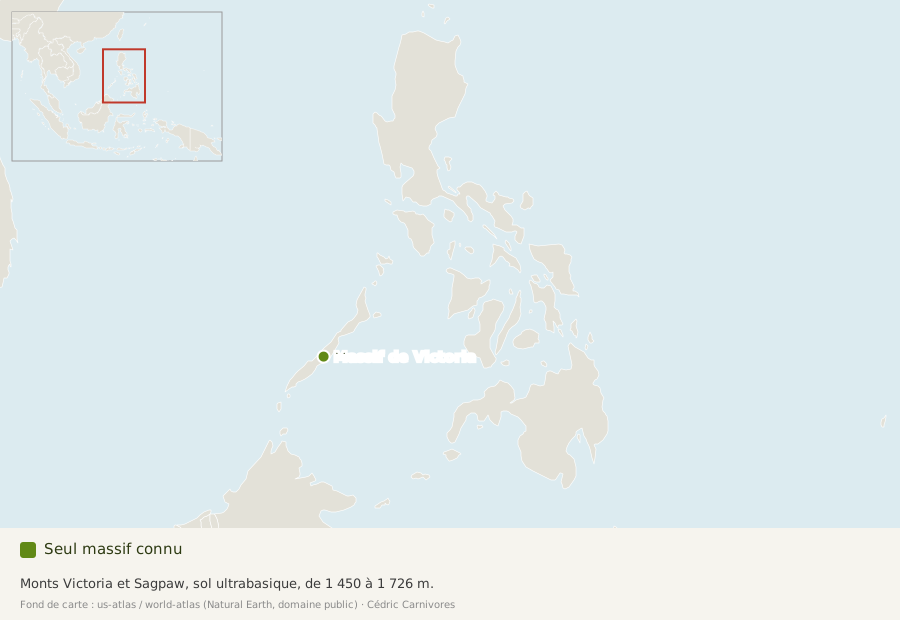
Endemic to the Victoria massif, in central Palawan: Mount Victoria, Mount Sagpaw (highest point of the massif) and the ridges that link them. From about 1,450 m to the summit of Mount Victoria (1,726 m).
Habitat
- Scattered populations among shrubs 0.8 to 1.8 m tall, on rocky ultramafic soil;
- at the summit, with Leptospermum, Medinilla, Dracaena, Vaccinium, grasses and the sundew Drosera ultramafica.
Ecology
- Two layered fluids: its pitchers, open to the rain, often contain fluid in two layers that do not mix, viscous at the bottom, watery at the top. The upper layer is home to mosquito larvae; the plant probably also benefits from their waste.
- Prey: mainly large crawling and flying insects.
- The press's “rats”: in 2009, newspapers wrote that it ate rats, although no rodent had been seen in its pitchers. In October 2012, a dead shrew was found in a pitcher; in December, when filmed, only the skeleton and a few hairs were left.
Relationships
Close to the other species of Palawan (N. deaniana, N. leonardoi, N. mantalingajanensis, N. mira, N. palawanensis), to N. peltata (Mindanao) and to N. rajah (Borneo). Its describers think that these species of ultramafic soils descend from a common ancestor that came from Borneo.
Natural hybrids
None: no other Nepenthes grows with it.
Threats and protection
- “Critically endangered” for the IUCN: tiny range and poaching.
- 2010: chosen among the top 10 new species described in 2009 (International Institute for Species Exploration, Arizona State University).
- 2012: placed on the list of the 100 most threatened species in the world (IUCN and Zoological Society of London).
- Its discovery helped to mobilise local people to protect Mount Victoria.
Sources
- Wikipedia (English), Nepenthes attenboroughii: 2009 description, missionaries, 2007 expedition, specimen, description, volumes, range, altitude, habitat, summit flora, two-layer fluid, 2012 shrew, relationships, status, distinctions.
- Wikipedia (English), Nepenthes palawanensis: role in the protection of Mount Victoria.