Nepenthes barcelonae Tandang & Cheek
Species sheet, updated on 30/10/2026. Short sheet: sources on this species are still scarce.
At a glance
| Scientific name | Nepenthes barcelonae Danilo Tandang & Martin Cheek, Phytotaxa 222, 2015 |
| Family | Nepenthaceae |
| Distribution | Sierra Madre, Aurora province, Luzon (Philippines) |
| Habitat | Stunted mid-mountain forest, from 1,500 to 1,700 m |
| Status | Critically endangered according to its authors (a single site, less than 10 km²) |
Etymology
- Nepenthes: see the genus sheet.
- barcelonae: in honour of the botanist Julie F. Barcelona, who discovered it.
History of the description
- February 2014: Julie Barcelona, Danilo Tandang and Pieter Pelser discover it in the Sierra Madre.
- 2015: description; the exact locality is kept secret to protect it from collectors.
Description (how to recognise it)
- According to its description (2015): in section Insignes, it is unique for its recessed mouth and its upper pitchers of two colours and two shapes, a phenomenon never observed in the genus: the first ones are red, larger and squat, on a long uncoiled tendril; the following ones green, smaller and slender, on a coiled tendril.
Distribution
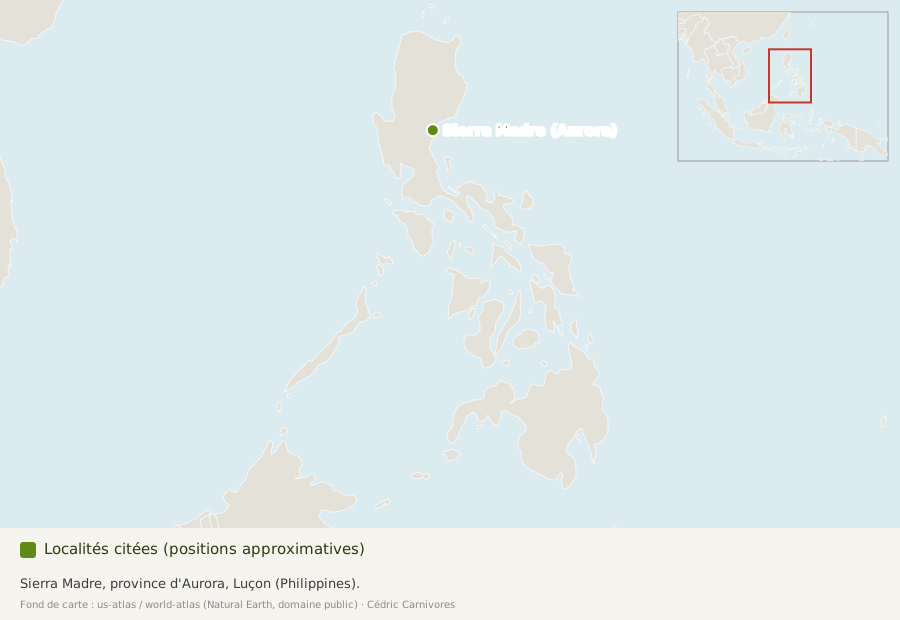
Endemic to Luzon: Sierra Madre, Aurora province, from 1,500 to 1,700 m.
Habitat
Stunted mid-mountain forest. Its only known population covers less than 10 km² on a single mountain (Sierra Madre, Luzon); threatened by collecting for horticulture, it is classified as “critically endangered”.
Threats and protection
A single site. Threats: poaching by collectors, slash-and-burn farming and illegal logging further down.
Did you know?
- Its closest relatives are N. ventricosa, very widespread on Luzon, and N. alzapan.
Sources
- Wikipedia (English), Nepenthes barcelonae: publication, etymology, discovery, range, altitude, habitat, threats, status, relationships.
- “Nepenthes barcelonae, a new species from Luzon, Philippines”, Phytotaxa 222, 2015: abstract of the paper.
- GBIF, Nepenthes barcelonae: author, original publication, countries and localities of the herbarium specimens and observations.