Nepenthes bicalcarata Hook. f.
Species sheet, updated on 29/10/2026.
At a glance
| Scientific name | Nepenthes bicalcarata Joseph Dalton Hooker, 1873 |
| Former name | N. dyak S. Moore, 1880 (synonym) |
| Family | Nepenthaceae |
| Common names | Fanged pitcher-plant; in French népenthès à crocs |
| Distribution | Borneo: swamp forests of the west coast (Sarawak, Sabah, Kalimantan, Brunei) |
| Habitat | Peat swamp forest, heath forest on white sand, usually below 300 m |
| Status | Vulnerable (IUCN) |
Photos in the wild
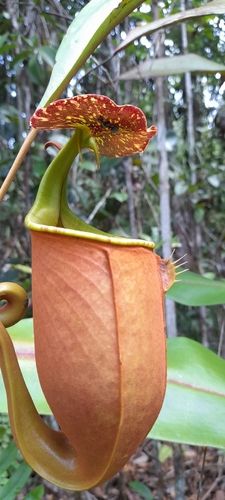
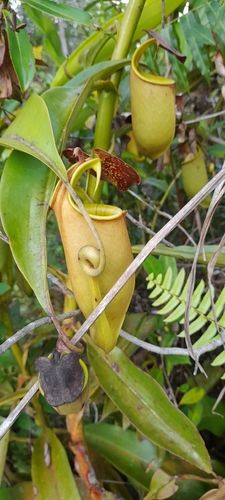
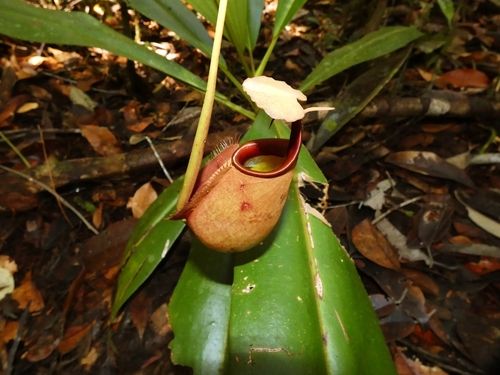
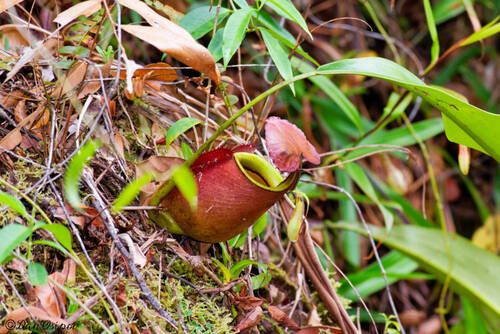
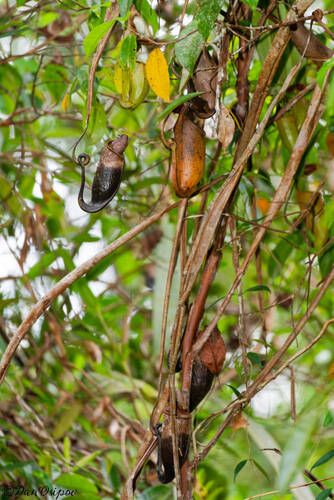
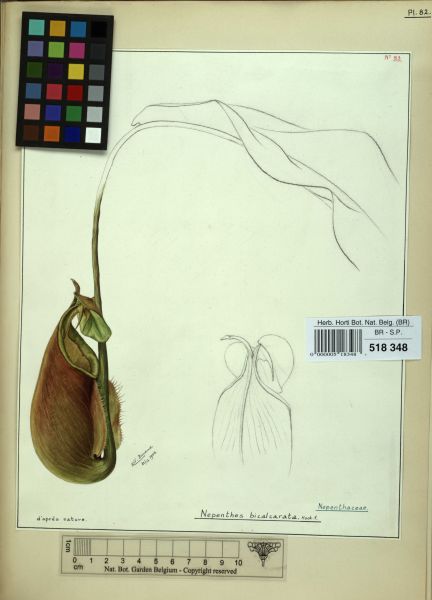
Etymology
- Nepenthes: see the genus sheet.
- bicalcarata: from the Latin, “with two spurs”. The name refers to the two spines that hang below the lid of the pitcher, like fangs.
Description (how to recognise it)
- A giant climber: up to 40 m long, and able to climb 20 m up into the canopy. Its stems reach about 3.5 cm in diameter: they are the thickest of all Nepenthes.
- The fangs: two spines up to 3 cm long, under the lid, bearing large nectar glands.
- The lower pitchers: up to about 25 cm tall, and they can hold more than a litre.
- Hollow tendrils: its swollen, hollow tendrils serve as ant nests.
Distribution
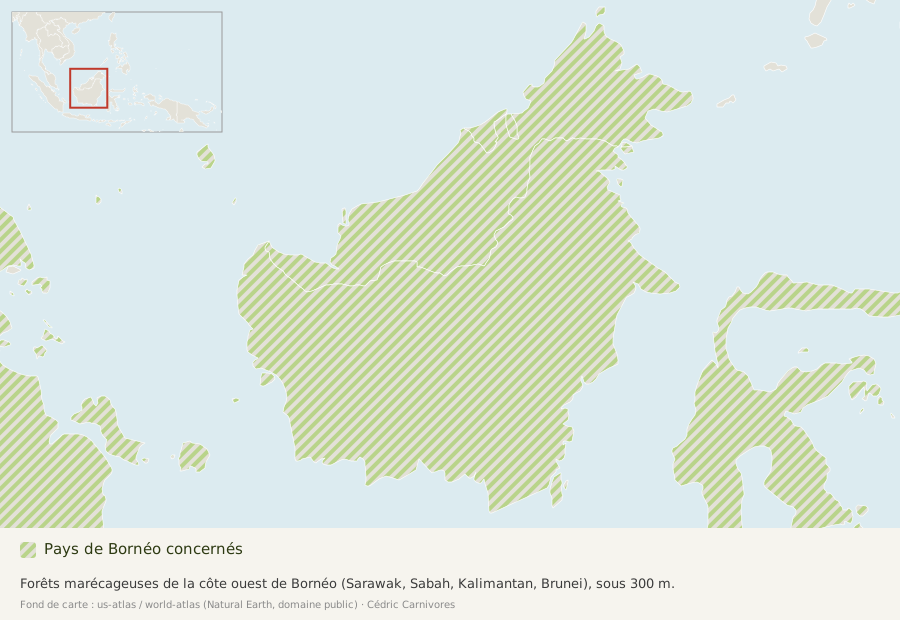
Endemic to Borneo, mainly in the peat swamp forests of the west coast: Sarawak, Sabah, Kalimantan and Brunei. Usually below 300 m; one collection from 1894 comes from 700 to 950 m.
Habitat
- Peat swamp forest;
- also in kerangas (heath forests) and forests on white sand;
- it often grows with N. ampullaria.
Ecology: an alliance with an ant
- The ant Camponotus schmitzi lives in its hollow tendrils. It feeds on prey that has fallen into the pitcher, cleans the peristome, and protects the plant from the weevils that eat the pitchers.
- An unequal alliance: the plant can live without the ant, but the ant cannot live without the plant.
- What are the fangs for? Their role is debated: they might lure insects above the pitcher so that they fall in, or deter climbing mammals from raiding the pitcher.
Natural hybrids
| Hybrid | Other parent |
|---|---|
| N. × cantleyi | N. gracilis |
| unnamed | N. ampullaria, N. mirabilis var. echinostoma, N. rafflesiana |
The hybrids are generally not inhabited by the ant C. schmitzi.
Threats and protection
“Vulnerable” according to the IUCN (2000 assessment). Charles Clarke considered it rather “near threatened” in 1997.
Did you know?
- It has the thickest stems of all Nepenthes, and two fangs under its lid.
- An ant lives in its tendrils and acts as its cleaner and bodyguard.
Sources
- Wikipedia (English), Nepenthes bicalcarata: Hooker 1873, synonym, etymology, description, range, altitude, habitat, Camponotus schmitzi, role of the fangs, hybrids, statuses.