Nepenthes bokorensis Mey
Species sheet, updated on 29/10/2026.
At a glance
| Scientific name | Nepenthes bokorensis François Sockhom Mey, Carniflora Australis, March 2009 |
| Synonym | N. bokor Cheek (2009, published later) |
| Khmer name | ampuong sramoch, “ants' chamber pot” (for all Nepenthes) |
| Family | Nepenthaceae |
| Distribution | Mount Bokor massif, Kampot province (Cambodia) |
| Habitat | Upland thickets that are dry part of the year, on acidic sand, from 800 to 1,080 m |
| Status | “Potentially vulnerable” according to Mey (2009) |
Photos in the wild
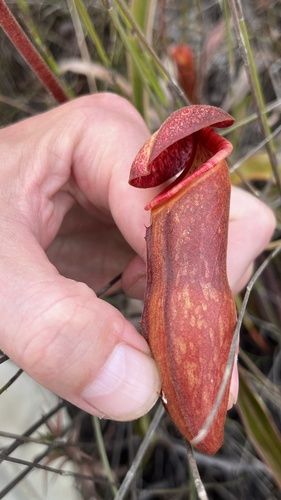
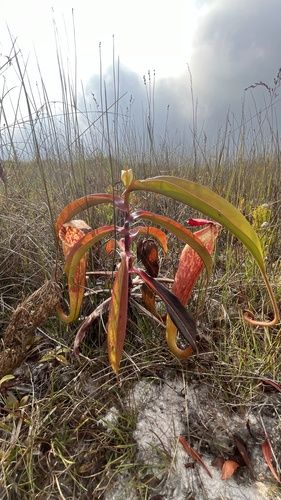
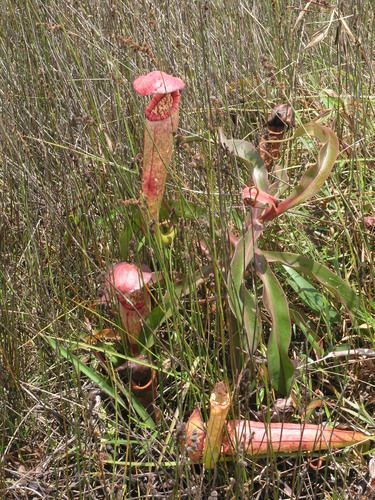
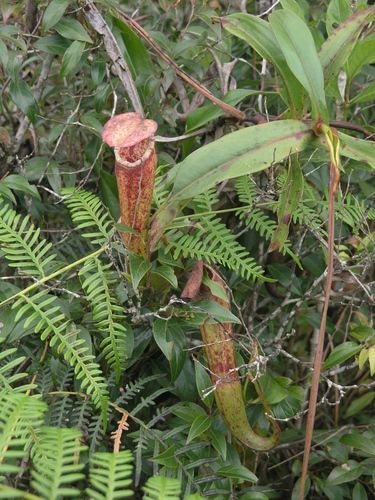
Etymology
- Nepenthes: see the genus sheet.
- bokorensis: from Mount Bokor and its national park.
History of the discovery
- 14 January 1904: C. Geoffray collects the oldest known specimens at the Popokvil Falls (960 m).
- Other collections follow: perhaps Chevalier (1917), J. E. Vidal (1965), Marie Martin (1968), Middleton and Monyrak (2001).
- 7 December 1968: Marie Martin collects on Mount Bokor, at about 800 m, the specimen that will become the type (Muséum national d'histoire naturelle, Paris).
- July 2007: François Mey finds the plant again on Mount Bokor; he describes it in 2009.
- August 2011: Mey and Alastair Robinson discover two large new populations.
Description (how to recognise it)
- A climber up to 7 m.
- Leaves: leathery, narrow, up to 35 cm by 8, clasping the stem.
- Lower pitchers: up to 20 cm, swollen at the bottom then cylindrical, with fringed wings.
- Upper pitchers: up to 25 cm, funnel-shaped, very variable in shape and colour.
- Hairs: silvery or brownish over the whole plant, sometimes almost absent.
- In full sun, the plants stay dwarf and can flower at less than 60 cm.
Distribution
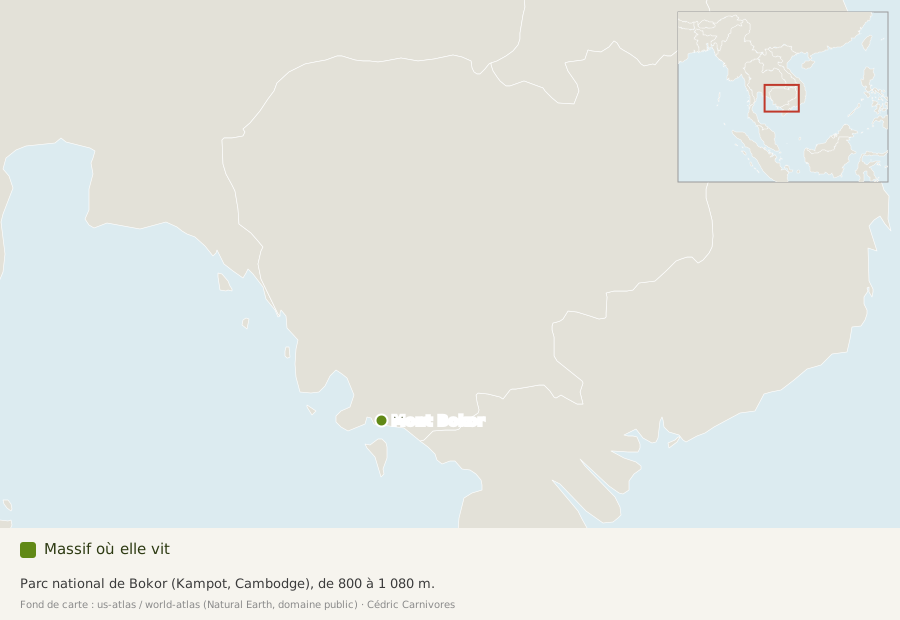
Endemic to Cambodia: known for certain from the Mount Bokor massif, in Bokor National Park (Kampot province), from 800 to 1,080 m. Three populations are known. An unidentified specimen suggests that it also occurs elsewhere in the Elephant Mountains (Dâmrei).
Habitat
- Upland thickets that are dry part of the year and stunted lower montane forest, under scattered trees;
- sandy, acidic soils (pH 4.6 in one sample);
- with sundews (Drosera peltata, D. burmanni), several bladderworts, grasses, shrubs and orchids on rocks.
Ecology: an ant eater
- Ants are its main prey: a 2012 study of 30 pitchers found 10 ant species; Polyrhachis made up 40% of the catch.
- Its fluid is very acidic (pH 2.7 on a herbarium label).
Relationships
Close to N. kampotiana, N. smilesii, N. thorelii and N. kerrii (Thailand).
Natural hybrids
With N. kampotiana.
Threats and protection
- Threats: tourism, the development of leased land on Mount Bokor and the “Bokor City” project, which sped up the destruction of the habitat from 2009 to 2011.
- 2022: the Cambodian Ministry of Environment asked the public to stop picking these plants: walkers were pulling them up to take photos of themselves with them, because the young pitchers look like male genitals. The ministry warned that this picking could drive the species to extinction.
Sources
- Wikipedia (English), Nepenthes bokorensis: Mey 2009, synonym, Khmer name, early collections, Martin 1968 specimen, 2011 populations, description, range, altitude, habitat, soil, companion plants, ants (2012 study), pH, relationships, hybrid, threats, 2022 appeal.