Nepenthes boschiana Korth.
Species sheet, updated on 29/10/2026.
At a glance
| Scientific name | Nepenthes boschiana Pieter Willem Korthals, 1839 |
| Common name | In French “Népenthès de Bosch” |
| Local name | daoen sompitan, roughly “blowpipe leaf” |
| Synonym | N. borneensis |
| Family | Nepenthaceae |
| Distribution | Meratus Mountains, South Kalimantan (Borneo) |
| Habitat | Open, stony, poor places |
| Status | Endangered (IUCN, 2000) |
Etymology
- Nepenthes: see the genus sheet.
- boschiana: in honour of Johannes van den Bosch, Governor-General of the Dutch East Indies (position: historical note, not confirmed).
History of the description
Korthals described it in 1839 in his monograph of the genus. He noted that the habitat was barren, open and stony.
Description (how to recognise it)
- According to Macfarlane (1908): a robust plant, climbing high; stem 5 to 10 m, winged, with reddish-brown hairs when young; leathery leaves 20 to 30 cm by 5 to 7 cm, on a winged petiole 4 to 9 cm long; tendril 20 to 35 cm.
- Pitchers 10 to 35 cm, of 2 or 3 shapes, green or reddish green below, pale green spotted with purple above; lower pitchers pot-bellied (10 to 15 cm by 7 to 8 cm), with broad wings; upper pitchers almost cylindrical to funnel-shaped, with a neck of 2 to 4 cm at the back; peristome 15 to 25 mm; heart-shaped lid, with reddish-brown hairs on top.
- Flower clusters 30 to 70 cm, densely covered with reddish-brown hairs. Local name recorded by Macfarlane: “Dawon-sompitan”.
Distribution
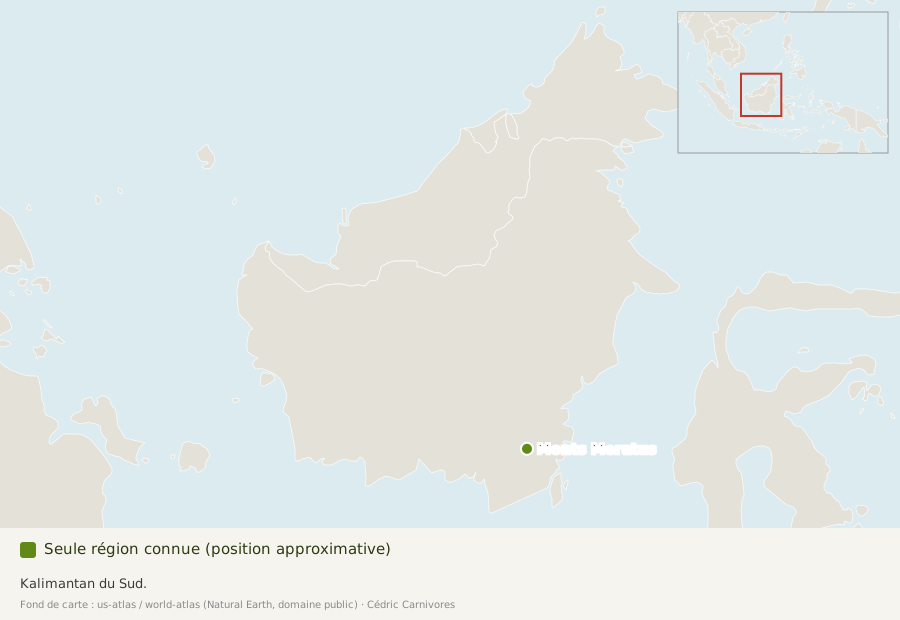
Endemic to the Meratus Mountains, in South Kalimantan.
Habitat
Korthals's type specimen was collected on Mount Sakumbang, at about 1,000 m (Borneo). Macfarlane (1908), who understood the species more broadly than today, also included collections from northern Borneo (Mount Mulu and Mount Dulit, 1,000 to 1,500 m; Lawas River).
Relationships
Its closest relative is N. faizaliana; it belongs to the maxima complex. Two former varieties, lowii and sumatrana, now refer to other species.
Natural hybrids
None known.
Threats and protection
“Endangered” according to the IUCN (2000).
Did you know?
- According to Korthals, local people collected the still-closed pitchers: their water was used as a remedy for eye inflammation. Others cut up the pitchers to make children's toys.
Sources
- Wikipedia (English), Nepenthes boschiana: Korthals 1839, etymology, local name, range, habitat, relationships, synonyms, status, local uses.
- GBIF, Nepenthes boschiana: author, original publication, countries and localities of herbarium specimens and observations.
- Macfarlane, Das Pflanzenreich IV.111: Nepenthaceae, 1908 (archive.org): description, localities and altitudes of the specimens (translated from Latin and German).