Nepenthes campanulata Sh. Kurata
Species sheet, updated on 29/10/2026.
At a glance
| Scientific name | Nepenthes campanulata Shigeo Kurata, 1973 |
| Common name | In French “Népenthès en cloche” |
| Family | Nepenthaceae |
| Distribution | Borneo (East Kalimantan, Sarawak); perhaps Palawan |
| Habitat | Damp, mossy limestone cliffs, from 100 to 300 m |
| Status | Vulnerable (IUCN, 2014) |
Etymology
- Nepenthes: see the genus sheet.
- campanulata: from the Late Latin campanulatus, “bell-shaped”, for its bell-like pitchers.
History: a species thought to be extinct
- 9 September 1957: A. J. G. “Doc” Kostermans, head of the botanical division of the Forest Research Institute in Bogor, collects it on the rock of Mount Ilas Bungaan, in East Kalimantan. It took him about ten days travelling up river. The rock was covered with Nepenthes; the team climbed the 50 m cliff using a felled tree as a ladder. In the caves of the rock, they found boat-shaped coffins, with ends carved into dogs' heads, containing headless skeletons.
- 1973: Shigeo Kurata describes it from this single specimen, without flowers or fruit.
- 1983: forest fires destroy the original population. All known populations disappear in late 1991 or early 1992: it is thought to be extinct.
- 1997: Ch'ien Lee finds it again on limestone cliffs in Gunung Mulu National Park (Sarawak), more than 400 km from the original site. Its flowers are then described for the first time.
- July 2013: a very similar plant is photographed on the limestone cliffs of the Saint Paul formation, on Palawan (Philippines).
Description (how to recognise it)
- A small plant: stems 20 to 50 cm, spreading by underground stems and forming large clumps.
- Leaves: leathery, spatula-shaped, up to 12 cm by 2, with very short tendrils.
- Only one type of pitcher, which is rare among Nepenthes: bell-shaped, yellow-green, up to 10 cm tall and 5.5 cm wide, with two ribs at the front.
- Round, horizontal mouth, with a very reduced peristome.
- Digestive glands only in the lower quarter of the pitcher.
- Completely hairless.
Distribution
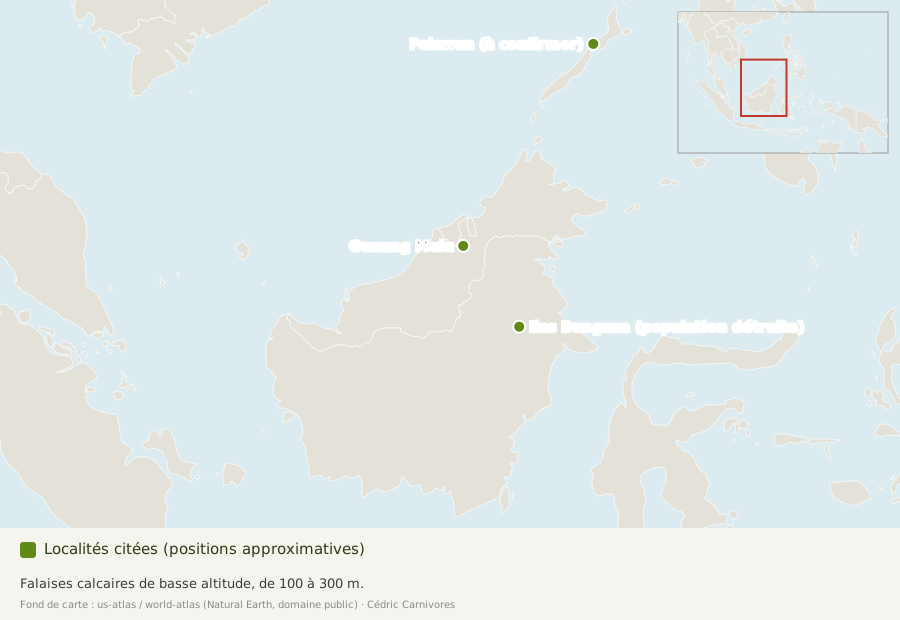
Borneo: Mount Ilas Bungaan (East Kalimantan, population destroyed) and Gunung Mulu National Park (Sarawak). Perhaps also Palawan (not confirmed; in the field, not confirmed).
Habitat
- Rock-dwelling plant (lithophyte) of the lowlands, from 100 to 300 m;
- on damp, mossy cliffs;
- apparently only on limestone.
Relationships
Kurata placed it close to N. inermis from Sumatra; most botanists do not follow him, as their habitats are so different.
Natural hybrids
None known.
Threats and protection
- “Vulnerable” according to the IUCN (2014).
- Fires have already wiped out its original population.
Sources
- Wikipedia (English), Nepenthes campanulata: Kurata 1973, Kostermans's 1957 account, fires of 1983 and 1991-1992, 1997 rediscovery, Palawan 2013, description, limestone habitat, relationships, status.