Nepenthes edwardsiana H. Low ex Hook. f.
Species sheet, updated on 29/10/2026.
At a glance
| Scientific name | Nepenthes edwardsiana Hugh Low ex Joseph Dalton Hooker, Transactions of the Linnean Society of London 22(4): 415-424, 1859 |
| Former name | N. edgeworthii Beck, 1895 (synonym) |
| Family | Nepenthaceae |
| Common names | Splendid pitcher-plant; in French “népenthès splendide” |
| Distribution | Mount Kinabalu and Mount Tambuyukon (eastern slope), Sabah (Borneo) |
| Habitat | Mossy ridge forest, always in the clouds, from 1,500 to 2,700 m |
| Status | Vulnerable (IUCN) |
Etymology
- Nepenthes: see the genus sheet.
- edwardsiana: Hooker named it, at Hugh Low's request, in honour of George Edwardes, governor of the British colony of Labuan. The Japanese specialist Shigeo Kurata suggested another origin: a botanical artist named S. Edwards.
History of the discovery
- 1858: Hugh Low and Spenser St. John collect the reference specimen on Mount Kinabalu. It is kept at Kew.
- 1859: Joseph Dalton Hooker describes it.
- Its status has changed several times; it was Macfarlane, in 1908, who reinstated it as a species in its own right.
Description (how to recognise it)
- Habit: a climbing plant, with stems up to 15 m.
- Giant pitchers: among the largest in the genus, usually about 30 cm, sometimes more than 50 cm.
- Upper pitchers: cylindrical and elongated, with a spectacular peristome, whose ribs reach about 2 cm.
- Its closest relatives: N. macrophylla and N. villosa.
Distribution
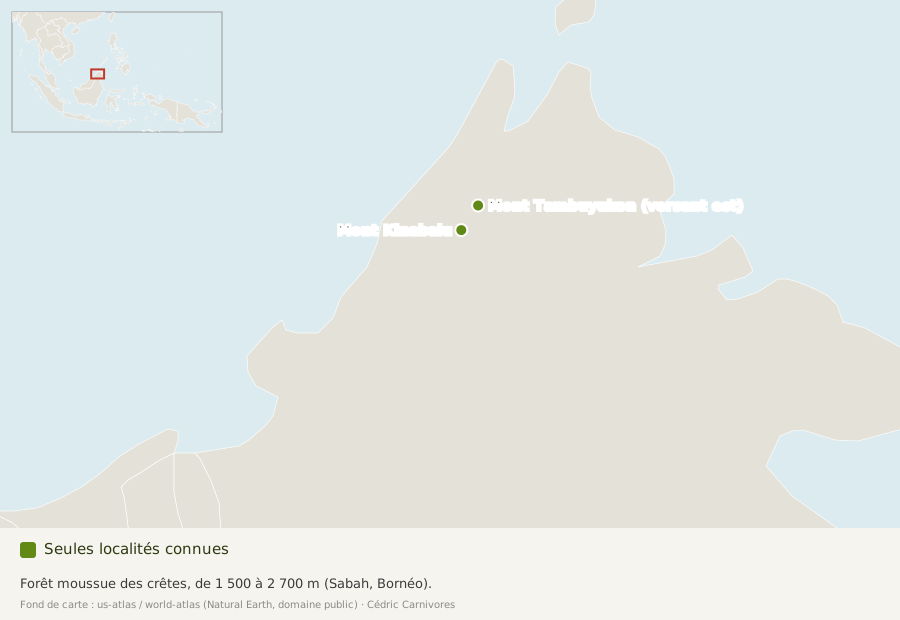
Endemic to the upper slopes of Mount Kinabalu and the eastern slope of Mount Tambuyukon, in Sabah (Borneo). From 1,500 to 2,700 m.
Habitat
- Mossy ridge forest, always damp and shrouded in clouds;
- it grows on trees (as an epiphyte) or on the ground, on mossy rocks, mainly on ultramafic soils;
- it climbs right up into the canopy.
- On the Marai Parai plateau, it grows among shrubs up to 5 m tall, and its pitchers there rarely exceed 30 cm.
Natural hybrids
| Hybrid | Other parent |
|---|---|
| N. × harryana | N. villosa (the best known) |
| unnamed | N. burbidgeae |
| unnamed | N. rajah |
Threats and protection
- “Vulnerable” according to the IUCN.
- The 1997-1998 El Niño event, with the drought and fires that followed, greatly reduced some populations.
- According to Charles Clarke, all its populations are in Kinabalu National Park, out of reach of collectors: it should not be threatened in the near future.
Did you know?
- The ribs of its peristome reach 2 cm: one of the finest “collars” in the genus.
Sources
- Wikipedia (English), Nepenthes edwardsiana: Hooker 1859, synonym, 1858 discovery, etymology, description, range, altitude, habitat, Marai Parai, El Niño, hybrids, status, relationships; references: Clarke 1997, Nepenthes of Borneo; Kurata 1976; Macfarlane 1908.