Nepenthes erucoides A. S. Rob. & S. G. Zamudio
Species sheet, updated on 30/10/2026.
At a glance
| Scientific name | Nepenthes erucoides Alastair Robinson, S. G. Zamudio & R. B. Caballero, Phytotaxa 423, 2019 |
| Family | Nepenthaceae |
| Distribution | Mount Redondo, Dinagat Island (Philippines) |
| Habitat | Ultramafic soils of nickel and chromite ore, from 800 to 929 m |
| Status | Critically endangered according to its authors |
Etymology
- Nepenthes: see the genus sheet.
- erucoides: from the Latin eruca, “caterpillar”, and the Greek -oides, “resembling”: its very hairy young leaves and tendrils recall the hairy caterpillars of certain moths.
Description (how to recognise it)
- The young shoots bear perhaps the densest hairs of all Nepenthes; the hairs fall off as the leaves mature.
- A small plant, with reduced, leathery leaves.
Distribution
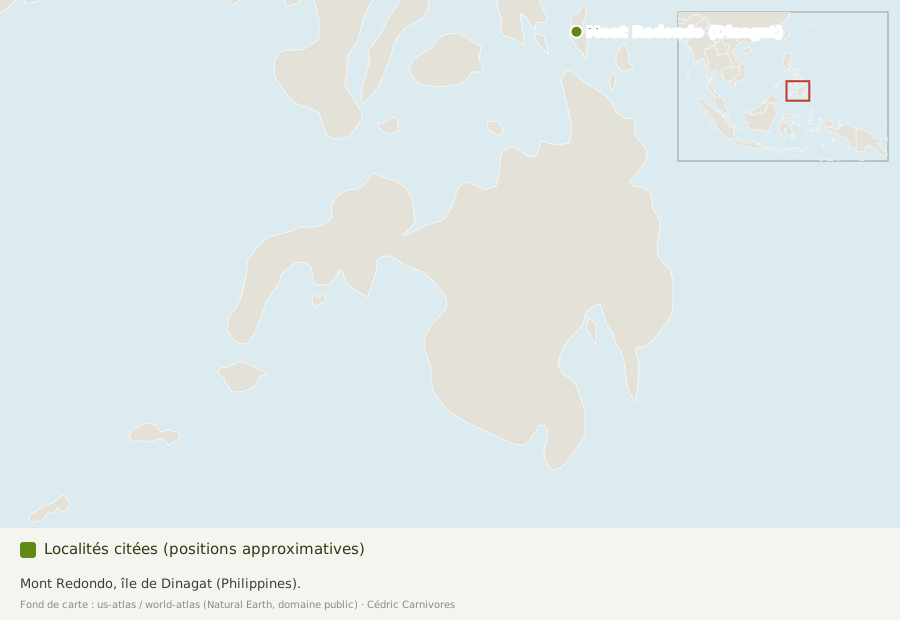
Endemic to Dinagat Island: Mount Redondo, the highest point, from about 800 m to the summit (929 m).
Habitat
Ultramafic soils of lateritic nickel ore and chromite scree, grading into clay: according to its authors, the most extreme ultramafic substrate known for a Nepenthes.
Ecology
It grows with N. mindanaoensis and N. bellii; N. truncata grows lower down, in the dwarf forest below 800 m, and N. merrilliana in the area below 600 m.
Natural hybrids
With N. mindanaoensis.
Threats and protection
A tiny range and a habitat that is being degraded.
Did you know?
- Its resemblance to N. mantalingajanensis (Palawan) and N. argentii (Sibuyan) is probably a case of convergence: its true relationships remain to be established through genetics.
Sources
- Wikipedia (English), Nepenthes erucoides: publication, etymology, hairiness, range, altitude, soil, companion species, hybrid, status, relationships.