Nepenthes extincta Jebb & Cheek
Species sheet, updated on 30/10/2026.
At a glance
| Scientific name | Nepenthes extincta Matthew Jebb & Martin Cheek, European Journal of Taxonomy 69, 2013 |
| Family | Nepenthaceae |
| Distribution | Surigao del Sur, Mindanao (Philippines) |
| Habitat | At about 400 m |
| Status | Perhaps already extinct in the wild |
Etymology
- Nepenthes: see the genus sheet.
- extincta: from the Latin, “extinct”: its authors think it may already have disappeared in the wild.
History of the description
- Known from a single herbarium specimen, collected in 1978.
- 2013: description.
Description (how to recognise it)
- It belongs to the N. alata group: winged petioles, ridges under the lid, upper pitchers wider towards the bottom.
- A terrestrial shrub about 1 m tall; thick, leathery elliptic leaves, 13 to 17 cm by 5.5 to 8 cm, glossy above, matt brown below; robust, ovoid-cylindrical pitchers, without fringed wings, with a lid truncate at the base.
- Very close to N. mindanaoensis, with which it perhaps shares a common origin; it is distinguished by these wingless pitchers and the greyish-white star-shaped hairs on the midrib.
Distribution
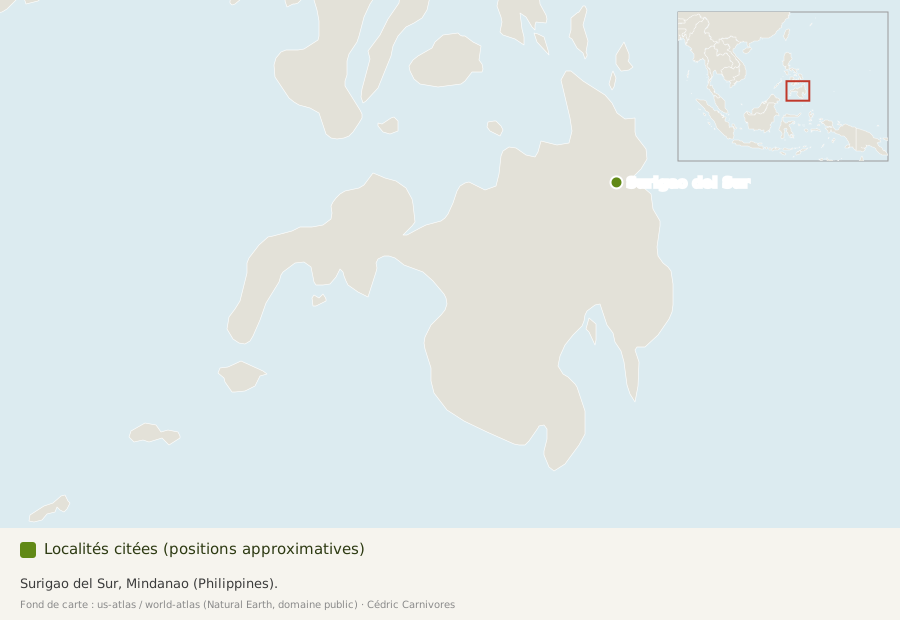
Mindanao: Surigao del Sur province, at about 400 m.
Habitat
Open thickets on ultramafic rocks, at about 400 m, with N. merrilliana and N. graciliflora, in the “Red Hills” south-east of Claver (Surigao, north-eastern Mindanao); only one plant has ever been collected (1978): “critically endangered”, and named extincta because it may already have disappeared.
Natural hybrids
The single specimen might be a natural hybrid N. merrilliana × N. mindanaoensis, two species that grow near the site and share many of its features.
Sources
- Wikipedia (English), Nepenthes extincta: publication, etymology, 1978 specimen, range, altitude, hybrid hypothesis, N. alata group.
- “Recircumscription of the Nepenthes alata group in the Philippines, with four new species” (Plazi text, public domain, via GBIF): original description, habitat, conservation.
- GBIF, Nepenthes extincta: author, original publication, countries and localities of herbarium specimens and observations.