Nepenthes eymae Sh. Kurata
Species sheet, updated on 30/10/2026.
At a glance
| Scientific name | Nepenthes eymae Shigeo Kurata, The Journal of Insectivorous Plant Society 35, 1984 |
| Synonyms | N. infundibuliformis J. R. Turnbull & A. T. Middleton (1984) |
| Family | Nepenthaceae |
| Distribution | Central and western Sulawesi (Indonesia) |
| Habitat | Heath forests, riverbanks, cliffs, scree slopes, from 1,000 to over 2,000 m |
| Status | Least concern (IUCN, 2018) |
Photos in the wild
Etymology
- Nepenthes: see the genus sheet.
- eymae: in honour of the Dutch botanist Pierre Joseph Eyma, who discovered it (Kurata had written “eymai”, later corrected).
History of the description
- 1938: Pierre Joseph Eyma discovers it in central Sulawesi.
- 5 November 1983: the type specimen is collected on the northern spur of Mount Lumut, at 1,850 m.
- 1984: Shigeo Kurata describes it; Turnbull and Middleton publish the same plant as N. infundibuliformis four days later: Kurata's name has priority.
Description (how to recognise it)
- A climber up to 8 m, with a yellow-green stem.
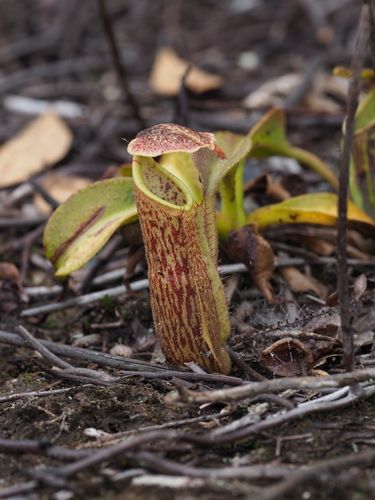
- Lower pitchers up to 24 cm by 16, often speckled with red.
- Upper pitchers shaped like a stemmed glass, up to 15 cm by 8, mostly yellow.
- Red tepals.
Distribution
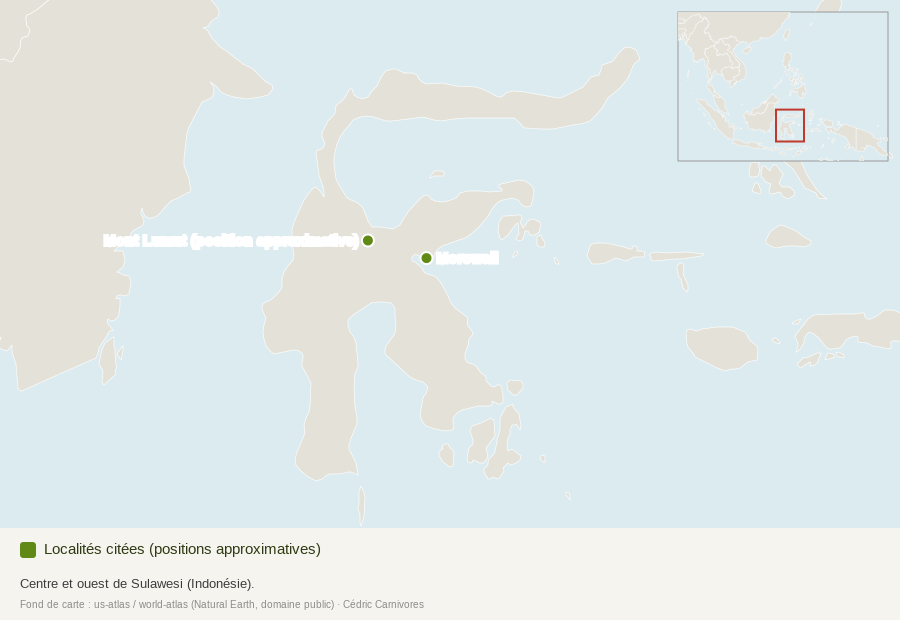
Endemic to Sulawesi: the centre (including the eastern peninsula) and the west of the island, from 1,000 to at least 2,000 m, mostly above 1,400 m. Only one protected area is home to it: the Morowali Nature Reserve.
Habitat
Mostly terrestrial, sometimes epiphytic at higher altitudes: heath forests, riverbanks, cliffs, landslides and disturbed forests.
Ecology
Its thick, viscous fluid also turns its pitchers into sticky traps for flying insects. In cultivation, the lower pitchers mainly catch ants.
Natural hybrids
None confirmed; gene exchange is possible where it grows alongside N. maxima.
Did you know?
- Very close to N. maxima, from which it differs mainly by its upper pitchers; it belongs to the N. maxima complex.
Sources
- Wikipedia (English), Nepenthes eymae: publication, priority over N. infundibuliformis, etymology, history, description, range, altitude, habitat, viscous fluid, status, relationships.