Nepenthes faizaliana J. H. Adam & Wilcock
Species sheet, updated on 29/10/2026.
At a glance
| Scientific name | Nepenthes faizaliana J. H. Adam & C. C. Wilcock, Blumea, 1991 |
| Family | Nepenthaceae |
| Distribution | Limestone cliffs of Gunung Mulu National Park (Sarawak) |
| Habitat | Limestone outcrops and exposed ridges, generally from 1,000 to 1,600 m (down to 400 m) |
| Status | Least concern (IUCN) |
Etymology
- Nepenthes: see the genus sheet.
- faizaliana: in honour of Muhammad Khairul Faizal, the son of J. H. Adam, one of the two authors of the description.
History of the description
- 10 November 1981: the reference specimen is collected on Batu Panjang, in Gunung Mulu National Park (herbarium of the Sarawak Forest Department, in Kuching).
- 1991: description.
- 1997: Jebb and Cheek include it in N. stenophylla; Clarke keeps it as a species, and other authors have followed him since.
Description (how to recognise it)
- Upper pitchers: shaped like a narrow funnel, they can exceed 30 cm. The lower pitchers are smaller and rarer.
- Peristome wider and more colourful than that of N. stenophylla.
- Lid round, with a glandular crest.
- Leaves: up to 14 cm by 4.
Distribution
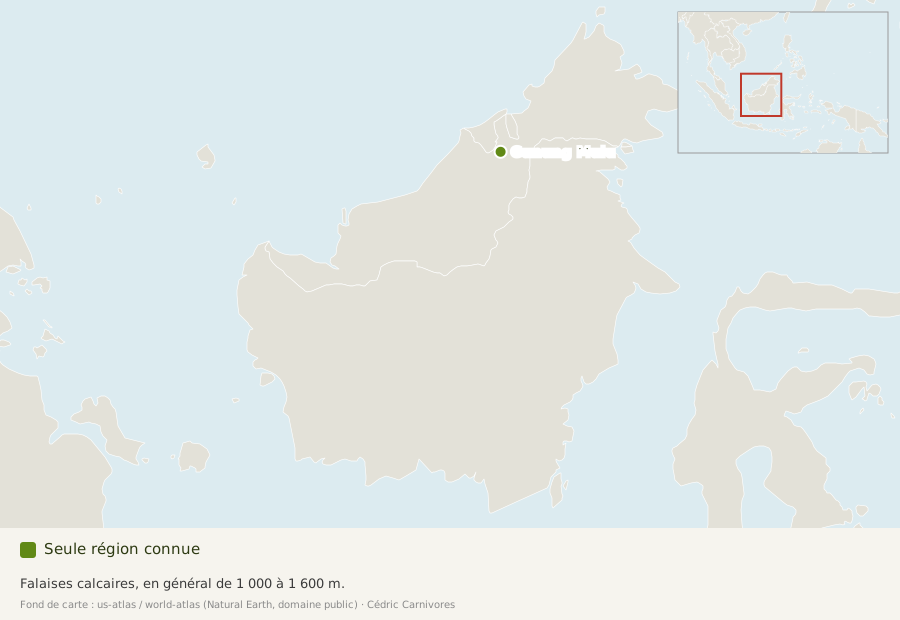
Endemic to the limestone cliffs of Gunung Mulu National Park (Sarawak), generally from 1,000 to 1,600 m, sometimes from as low as 400 m.
Habitat
On the ground or on trees, on limestone outcrops and exposed ridges.
Relationships
Its closest relative is N. boschiana, from which it differs mainly by its more visible hairs. Maxima group.
Natural hybrids
One presumed hybrid with N. veitchii.
Did you know?
- Most of its populations are isolated, but it is easy to see along the Pinnacles trail on Mount Api, famous for its limestone spires.
Sources
- Wikipedia (English), Nepenthes faizaliana: Adam & Wilcock 1991, 1981 specimen, etymology, description, range, altitude, habitat, relationships, hybrid, history of the name, status, Pinnacles trail.
- (“Famous for its limestone spires”: general reminder about the Pinnacles.)