Nepenthes flava Wistuba, Nerz & A. Fleischm.
Species sheet, updated on 29/10/2026.
At a glance
| Scientific name | Nepenthes flava Andreas Wistuba, Joachim Nerz & Andreas Fleischmann, Blumea, 4 July 2007 |
| Family | Nepenthaceae |
| Distribution | A single mountain in the Barisan Mountains, northern Sumatra (site kept secret) |
| Habitat | High-montane mossy forest with rhododendrons, from 1,800 to 2,200 m |
| Status | Not evaluated by the IUCN |
Etymology
- Nepenthes: see the genus sheet.
- flava: from the Latin flavus, “yellow”, for its bright yellow upper pitchers.
History of the description
- It had been grown for several years, at least since 2004, under the provisional name “Nepenthes spec. nov. Sumatra”.
- 2007: Wistuba, Nerz and Fleischmann describe it from a cultivated plant originating from 1,800 m, deposited at the National Herbarium of the Netherlands, in Leiden.
- 2009: Stewart McPherson gives a more detailed description.
Description (how to recognise it)
- A climber up to 6 m, which quickly moves from the rosette stage to a climbing stem.
- Leaves: narrow, up to 9 cm by 2.5, yellow-green.
- Lower pitchers: up to 7 cm, yellow, orange, red or purple.
- Upper pitchers: up to 6 cm, entirely yellow in typical plants, with a wide (up to 15 mm), wavy peristome.
- Yellowish inflorescence.
Distribution
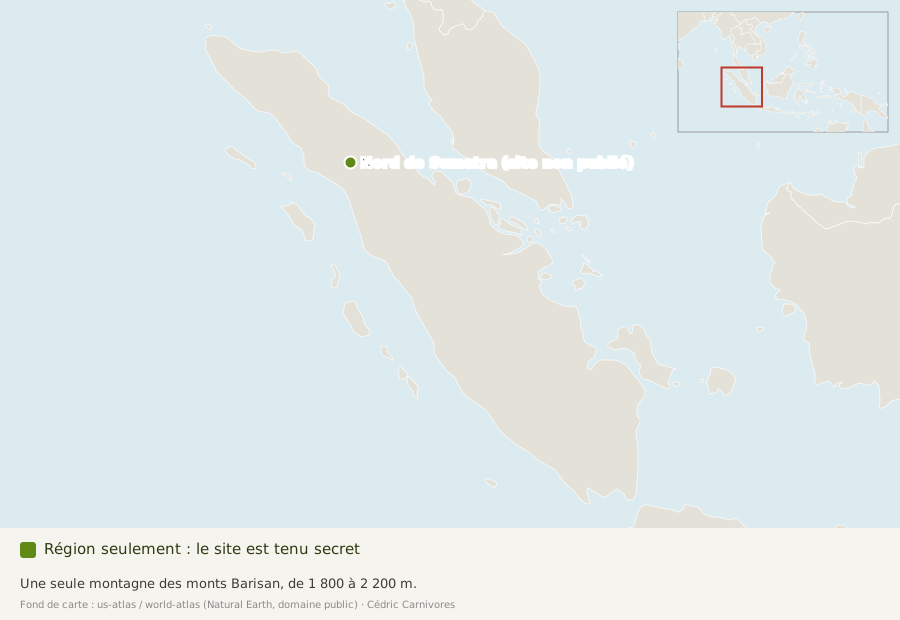
Endemic to northern Sumatra: a single mountain in the Barisan Mountains, whose location is not published in order to protect it. From 1,800 to 2,200 m.
Habitat
- High-montane mossy forest dominated by rhododendrons and Leptospermum;
- also on the ground in open forest, where the vegetation is no taller than 4 to 5 m;
- with N. mikei, N. ovata, N. rhombicaulis and N. spectabilis.
Ecology
Its very viscous fluid coats the walls, which matters for aerial pitchers exposed to the wind. Small flying insects get stuck to it, then slide into the fluid: a pitfall trap and flypaper at the same time.
Relationships
Close to N. inermis and N. jacquelineae; it cannot be their hybrid, because they do not grow together.
- Unlike N. jacquelineae, its upper pitchers are smaller, with a narrower peristome, and yellow.
- Unlike N. inermis, its upper pitchers have a peristome.
Natural hybrids
With N. ovata and N. rhombicaulis, mostly observed as young rosettes.
Threats and protection
Its only site is not in a national park. It seems abundant there, but McPherson considers it “highly exposed to poaching”, recalling the rapid decline of N. aristolochioides.
Sources
- Wikipedia (English), Nepenthes flava: 2007 description, provisional name, McPherson 2009, description, colours, range, altitude, habitat, fluid, relationships, hybrids, threats.