Nepenthes fusca Danser
Species sheet, updated on 29/10/2026.
At a glance
| Scientific name | Nepenthes fusca B. H. Danser, 1928 |
| Common name | Dusky pitcher-plant; in French népenthès sombre |
| Family | Nepenthaceae |
| Distribution | In the strict sense: the Kemul massif (East Kalimantan); in the broad sense: north-western Borneo |
| Habitat | Mossy ridge forest, mostly on trees, generally from 1,200 to 2,500 m |
| Status | Least concern (IUCN, 2018, in the broad sense) |
Etymology
- Nepenthes: see the genus sheet.
- fusca: from the Latin fuscus, “dark brown, dusky”, for the colour of its pitchers.
History of the description
- 12 October 1925: the forester Frederik Endert collects it on Mount Kemul, in East Kalimantan, at about 1,500 m, during the expedition on which he also discovers N. mollis.
- 1928: Danser describes it from this single specimen, with pitchers intermediate between lower and upper ones.
- 1997: Jebb and Cheek make it a broad, highly variable species.
- 2019: an expedition finds the Kemul population again, not seen since 1925. The study by Robinson and colleagues shows that the former N. fusca includes three species:
- N. fusca in the strict sense, from Kemul;
- N. zakriana, mainly in the Crocker Range in Sabah;
- N. dactylifera, further south (Brunei, Sarawak, Kalimantan).
Description (how to recognise it)
(In the broad sense.)
- A climber with stems up to 10 m.
- Leaves: up to 15 cm by 6.
- Lower pitchers: cylindrical, about 20 cm (up to 28 cm).
- Upper pitchers: funnel-shaped, up to 18 cm, sometimes 26 cm.
- Very narrow, triangular lid, with a crest at the base.
Distribution
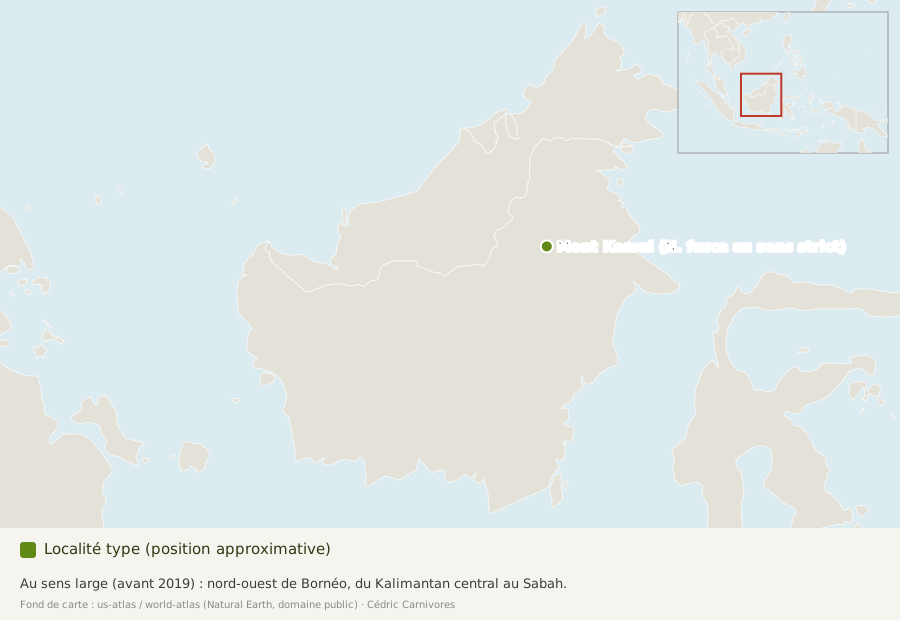
- In the strict sense: the Kemul massif, in East Kalimantan.
- In the broad sense (before 2019): north-western Borneo, from Central Kalimantan to north-western Sabah. Generally from 1,200 to 2,500 m, sometimes down to 600 m, or even 300 m in the hill forests of Sarawak.
Habitat
- Mostly on trees, in shady mossy ridge forest, sometimes 10 to 15 m above the ground;
- more rarely on the ground, in exposed places near montane forest or along forest tracks.
Natural hybrids
(In the broad sense.) With N. burbidgeae, N. lowii, N. stenophylla, N. tentaculata, N. platychila, N. rajah, N. veitchii; presumed with N. reinwardtiana.
Threats and protection
“Least concern” for the IUCN (2018). The main threat is habitat destruction; poaching matters little, as it is of little interest to collectors and grows high up in the trees.
Sources
- Wikipedia (English), Nepenthes fusca: Danser 1928, Endert 1925, etymology, description, range, altitude, habitat, hybrids, status, history of the classification.
- Robinson et al. 2019, Phytotaxa 392(2) (abstract): rediscovery on Kemul, split into three species.