Nepenthes glabrata Turnbull & Middleton
Species sheet, updated on 29/10/2026.
At a glance
| Scientific name | Nepenthes glabrata J. R. Turnbull & A. T. Middleton, Reinwardtia, 10 February 1984 (published as N. glabratus) |
| Family | Nepenthaceae |
| Distribution | Central Sulawesi (Indonesia) |
| Habitat | Open upper montane forest, on the ground, from 1,600 to 2,100 m |
| Status | Least concern (IUCN) |
Etymology
- Nepenthes: see the genus sheet.
- glabrata: from the Latin glaber, “glabrous, hairless”: the plant is almost entirely smooth.
History of the description
- 31 August 1983: Turnbull and Middleton collect the reference specimen in a logging concession in Central Sulawesi, at about 1,666 m. It was to be deposited at the Bogor herbarium, but Jebb and Cheek did not find it there: it may never have been sent.
- February 1984: they describe it, the same year as N. hamata. Four days earlier, Shigeo Kurata had published the name N. rubromaculata for the same plant; but that name had already been used in 1891 for a horticultural hybrid, so it is not valid.
Description (how to recognise it)
- A climber that can reach 13 m, with thin stems (3 mm).
- Leaves: narrow, up to 12 cm by 3; the tendril starts a little below the tip.
- Lower pitchers: small and round.
- Upper pitchers: short, cylindrical to slightly flared, up to 14 cm, with well-developed wings but no fringes.
- Colours: red speckles on a yellowish background, giving a “hand-painted” look (Peter D'Amato).
- Peristome narrow, finely ribbed, without teeth. Lid almost round.
Distribution
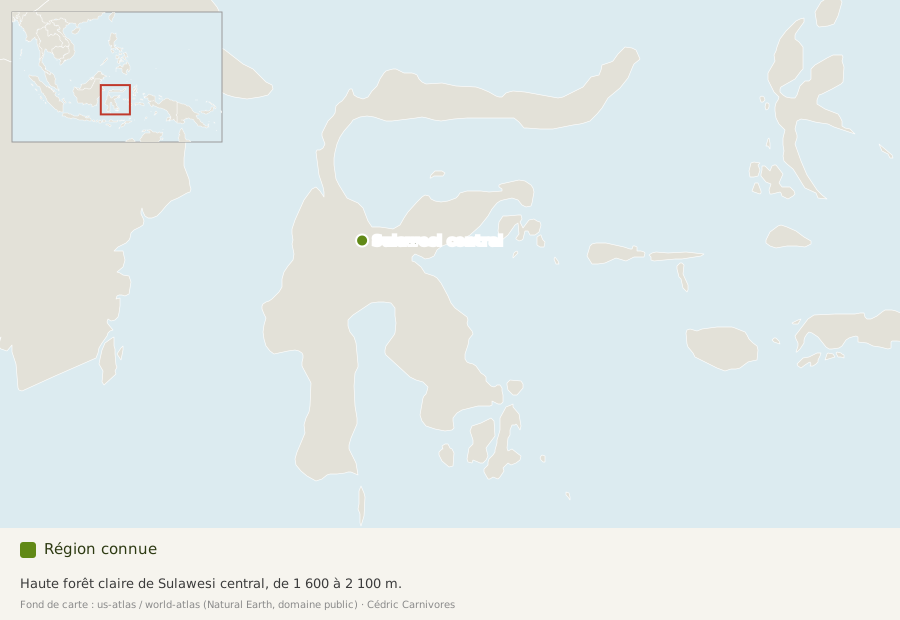
Endemic to Central Sulawesi (Indonesia), from 1,600 to 2,100 m.
Habitat
On the ground, in open upper montane forest. At one site at 1,600 m, it grows with N. maxima and the sundew Drosera burmanni.
Relationships
It belongs to the hamata* group (or tentaculata group), with N. hamata, N. muluensis, N. murudensis, N. nigra and N. tentaculata. Recent work names N. pitopangii*, another species from the mountains of Sulawesi, as its closest relative.
In cultivation
It has been grown since its description. Growers distinguish two forms: “Palo Alto”, compact, with leaves that turn purple in strong light, and “Forestville”, with slightly larger pitchers.
Natural hybrids
Where their ranges overlap, with N. hamata, N. maxima, N. nigra and N. tentaculata.
Threats and protection
“Least concern” for the IUCN (assessed in 2015, published in 2018).
Sources
- Wikipedia (English), Nepenthes glabrata: 1984 description, N. rubromaculata, specimen, etymology, description, range, altitude, habitat, hamata group, cultivated forms, hybrids, status.