Nepenthes glandulifera Chi. C. Lee
Species sheet, updated on 29/10/2026.
At a glance
| Scientific name | Nepenthes glandulifera Ch'ien C. Lee, 2004 |
| Family | Nepenthaceae |
| Distribution | Hose Mountains, central Sarawak (Borneo) |
Etymology
- Nepenthes: see the genus sheet.
- glandulifera: from the Latin glandula, “gland”, and ferre, “to bear”: “gland-bearing”. The name refers to the black dots on its petioles.
History of the description
Like N. platychila, it was reported in 2002 in a report on the Nepenthes of the Hose Mountains, under the provisional name Nepenthes sp. “A”. Ch'ien C. Lee described it in 2004.
Description (how to recognise it)
- A very hairy plant, covered in a thick coat of hairs.
- Black dots on the petioles: at first they were thought to be a disease. They are in fact nectar glands.
- Its close relative is thought to be N. pilosa.
Distribution
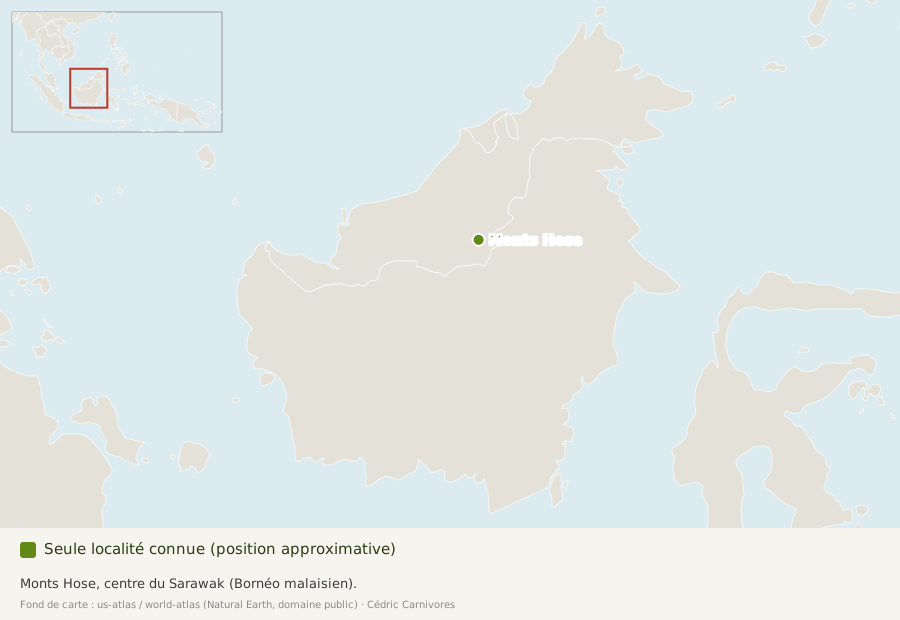
Endemic to the Hose Mountains, in central Sarawak (Malaysian Borneo).
Natural hybrids
None known.
Did you know?
- Its black dots, once mistaken for a disease, are glands that produce nectar.
Sources
- Wikipedia (English), Nepenthes glandulifera: Lee 2004, provisional name, etymology, description, nectar glands, range, relationships.
- GBIF, Nepenthes glandulifera: author, original publication, countries and localities of herbarium specimens and observations.