Nepenthes gracilis Korth.
Species sheet, updated on 29/10/2026.
At a glance
| Scientific name | Nepenthes gracilis Pieter Willem Korthals, 1839 |
| Common name | In French népenthès grêle |
| Family | Nepenthaceae |
| Distribution | Borneo, Sumatra, Peninsular Malaysia, Singapore, southern Thailand, Cambodia, central Sulawesi |
| Habitat | Lowlands, mostly below 100 m (up to 1,100 m, perhaps 1,700 m) |
| Status | Least concern (IUCN, 2018) |
Photos in the wild
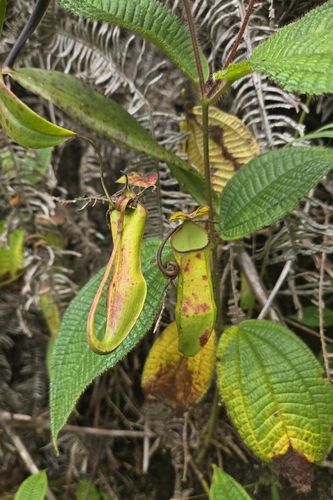
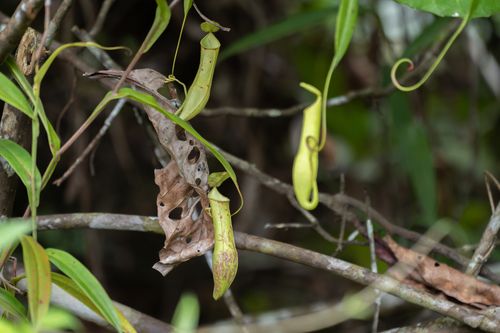
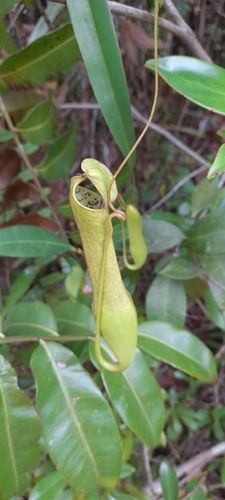
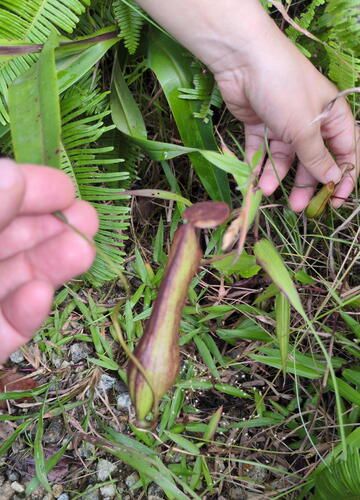
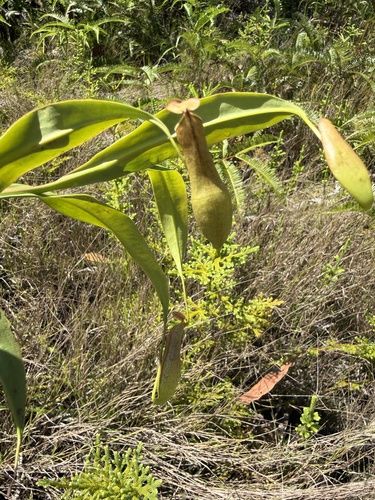
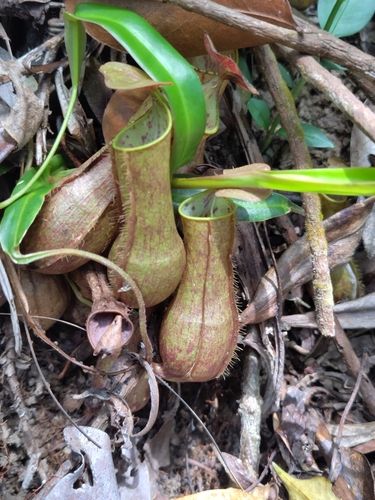
Etymology
- Nepenthes: see the genus sheet.
- gracilis: from the Latin gracilis, “slender, thin”.
History of the description
The Dutch botanist Korthals described it in 1839, in his monograph of the genus, one of the first.
Description (how to recognise it)
- Small, elongated pitchers, with a very thin peristome.
- The underside of the lid bears an irregular layer of wax crystals.
Distribution
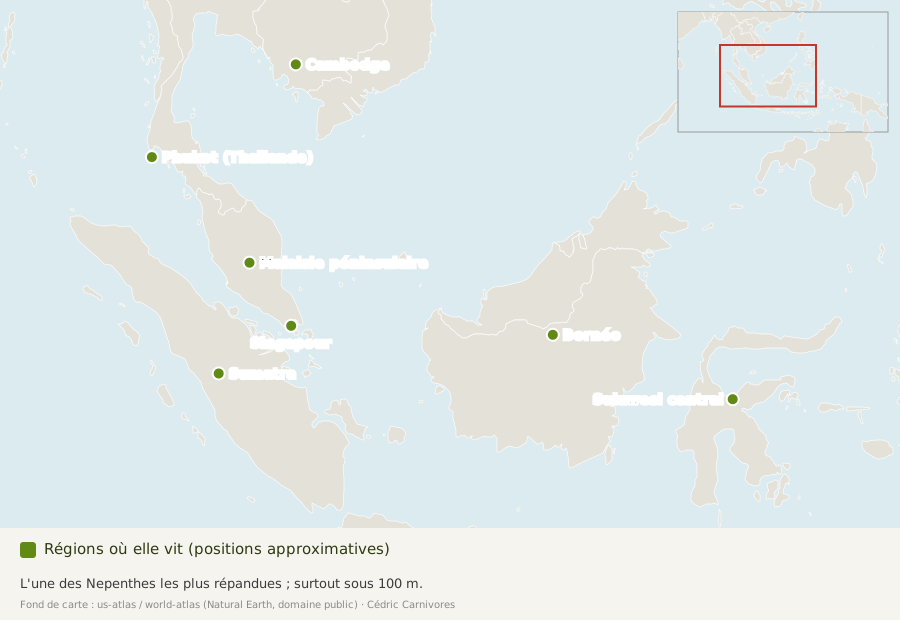
One of the most widespread Nepenthes: Borneo, Sumatra, Peninsular Malaysia, Singapore, southern Thailand, Cambodia and central Sulawesi, plus many small islands (Belitung, Labuan, Langkawi, Penang, Phuket…).
Altitude: from 0 to 1,100 m (perhaps 1,700 m), but most populations live below 100 m; it is rare above 1,000 m.
Habitat
A common lowland plant.
Ecology: a springboard lid
It may be the only Nepenthes to use its lid in this way:
- in dry weather, insects stick to the wax on the underside of the lid;
- in the rain, each drop that hits the lid makes it vibrate: insects standing underneath lose their footing and fall into the pitcher.
- Laboratory experiments showed simulated rain knocking ants off, and a high-speed video filmed a fly falling after a drop struck.
Relationships
Morphological and genetic studies disagree. Genetics places it next to the N. mirabilis group. N. abgracilis from the Philippines owes its name to its resemblance to it.
Natural hybrids
Rare: with N. albomarginata, N. ampullaria (N. × trichocarpa), N. bicalcarata (N. × cantleyi), N. mirabilis, N. northiana (N. × bauensis), N. rafflesiana, N. reinwardtiana and N. sumatrana.
Threats and protection
“Least concern” for the IUCN (C. M. Clarke, 2018).
Sources
- Wikipedia (English), Nepenthes gracilis: Korthals 1839, etymology, description, range, altitude, lid mechanism in the rain, experiments, relationships, hybrids, status.