Nepenthes hamata Turnbull & Middleton
Species sheet, updated on 29/10/2026.
At a glance
| Scientific name | Nepenthes hamata J. R. Turnbull & A. T. Middleton, Reinwardtia, 1984 (published as N. hamatus) |
| Synonym | N. dentata Kurata (1984) |
| Family | Nepenthaceae |
| Distribution | Central and eastern Sulawesi (Indonesia) |
| Habitat | Mossy forest and thickets on ridges and summits, from 1,400 to 2,500 m |
| Status | Least concern (IUCN, 2018) |
Etymology
- Nepenthes: see the genus sheet.
- hamata: from the Latin hamatus, “furnished with hooks”, for the hooked teeth of its peristome.
History of the description
- 3 September 1938: the Dutch botanist Pierre Joseph Eyma collects the first specimens on Mount Lumut, on Sulawesi.
- 1972: the Japanese botanist Shigeo Kurata sees these specimens at the Bogor herbarium and realises that this is a new species.
- 19 September 1983: Turnbull and Middleton collect the reference specimen on the western ridge of Mount Lumut, at 1,850-1,900 m.
- 1984: two descriptions appear almost at the same time: N. hamatus by Turnbull and Middleton and N. dentata by Kurata. After years of debate over priority, N. hamata is the name retained.
Description (how to recognise it)
- A vigorous climber, with stems up to 7 m.
- Lower pitchers: up to 18 cm, with wings fringed with long filaments.
- Upper pitchers: from 7 to 25 cm, more elongated.
- Perhaps the most spectacular peristome in the genus: ridges about 15 mm long, around twenty on each side, ending in sickle-shaped teeth about 7 mm long, up to 10 mm near the lid. The aerial pitchers have even longer, more widely spaced teeth.
- Lid: edged on its upper surface with long filaments, up to 45 on each side.
- Colours: highly variable from one plant to another, up to almost entirely purple pitchers.
Distribution
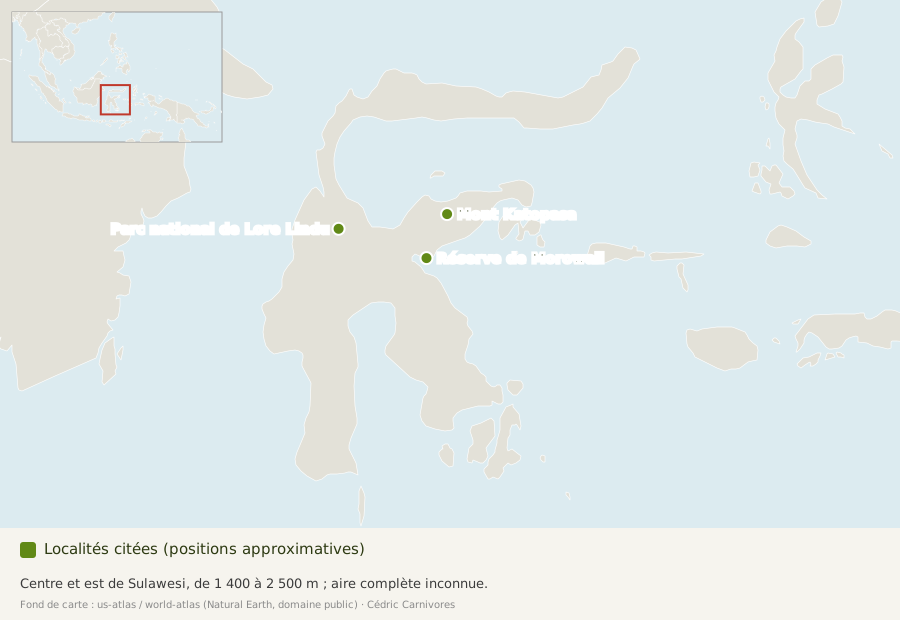
Endemic to Sulawesi (Indonesia), mainly in the east of Central Sulawesi and much of the eastern peninsula: Mount Lumut, Mount Katopasa. From 1,400 to 2,500 m. Its full range is not yet known.
Habitat
- Lower and upper montane mossy forest, thickets on ridges and summits;
- on the ground or on trees;
- very humid and partly shaded.
Relationships
It gives its name to the hamata* group: N. glabrata, N. muluensis, N. murudensis, N. nigra and above all N. tentaculata*, its closest relative. The latter has the same filaments on the lid, but no large teeth.
A form that became a species
In early 2005, Ch'ien Lee announces a very hairy form with red pitchers, from a distant mountain: the “hairy red hamata”. It is described in 2020 as a separate species: N. diabolica.
Natural hybrids
With N. glabrata (reported by Ch'ien Lee in December 2006) and N. tentaculata.
Threats and protection
- “Least concern” for the IUCN (C. Clarke, 2018). According to McPherson (2009), it is widespread and most populations are isolated and under little threat.
- It grows in Lore Lindu National Park and the Morowali Reserve.
Did you know?
- Until 1996, it was very rare in cultivation and sold for 300 to 400 dollars a plant, which encouraged collection from the wild. From 1995, Ch'ien Lee propagated it in vitro at his nursery Malesiana Tropicals, in Sarawak.
Sources
- Wikipedia (English), Nepenthes hamata: 1984 description, priority dispute, Eyma 1938, Kurata 1972, specimen, detailed description, range, altitude, habitat, hamata group, N. diabolica, hybrids, status, cultivation.