Nepenthes hemsleyana Macfarl.
Species sheet, updated on 29/10/2026.
At a glance
| Scientific name | Nepenthes hemsleyana John Muirhead Macfarlane, 1908 |
| Synonyms | N. baramensis (2011); former “elongated form” of N. rafflesiana (var. elongata) |
| Family | Nepenthaceae |
| Distribution | Brunei and northern Sarawak (Borneo) |
| Habitat | Wooded peat swamps and heath forests, below 200 m |
Etymology
- Nepenthes: see the genus sheet.
- hemsleyana: in honour of the English botanist William Botting Hemsley.
History: a name rediscovered
- 1877: Frederick William Burbidge collects it on a rocky hill in the Lawas region, in Sarawak (specimens at Kew).
- 1908: Macfarlane describes it and separates it from N. rafflesiana by its veins, thin tendrils and elongated pitchers.
- 1928: Danser merges it into N. rafflesiana. Growers then call it the “elongated form”.
- 2011: Clarke, Moran and Lee describe it again under the name N. baramensis.
- 2013: Scharmann and Grafe show that the older name hemsleyana is the correct one.
Description (how to recognise it)
- It resembles N. rafflesiana, but everything is elongated: pitchers, leaves, tendrils.
- Tendrils round in cross-section.
- Upper pitchers keeping a well-developed waxy zone.
- Lid often bearing fine, hair-like appendages.
- In closed forest, leaves dark green or reddish.
Distribution
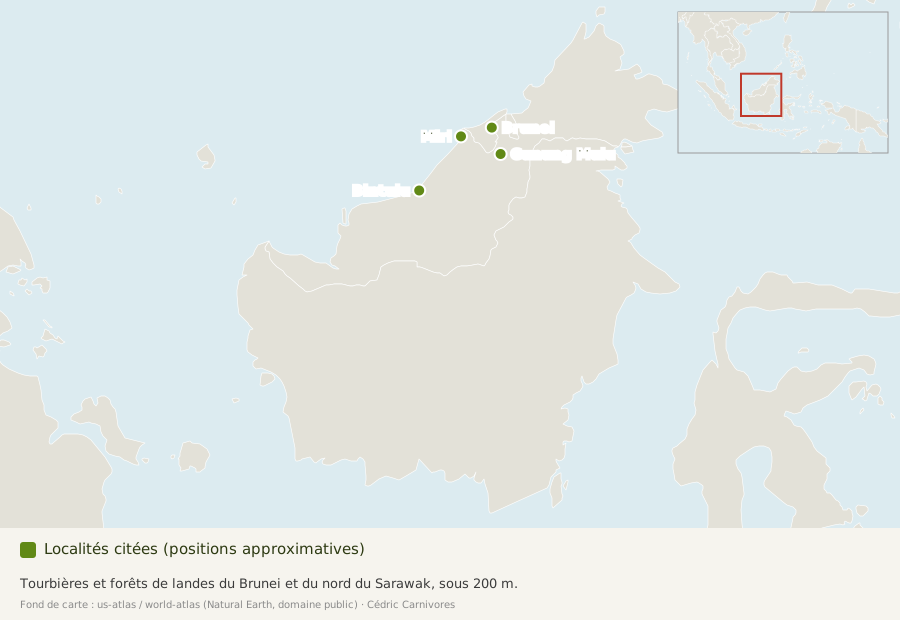
Confirmed in Brunei and northern Sarawak: the Baram and Bintulu regions, around Miri and in Gunung Mulu National Park. A record from West Kalimantan is not confirmed. Its type locality may have been destroyed by logging and oil palms.
Habitat
Wooded peat swamps and heath forests (kerangas), below 200 m.
Ecology: a bat hotel
- A small bat, Hardwicke's woolly bat (Kerivoula hardwickii), roosts in its upper pitchers.
- The bat finds a shelter with a stable climate there, and the plant recovers nitrogen from its droppings: about 34% of the nitrogen in its leaves.
- An ultrasound reflector: the back wall of the pitcher has a parabolic shape that strongly reflects the echo of the bat's calls. This probably helps it find the plant in dense vegetation. This bat's calls start above 250 kHz, among the highest-pitched known.
- The bats prefer it to the pitchers of N. bicalcarata.
Natural hybrids
With N. ampullaria and N. rafflesiana, in Brunei, but only in disturbed habitats.
Sources
- Wikipedia (English), Nepenthes hemsleyana: Macfarlane 1908, Burbidge 1877, history of the name (Danser 1928, N. baramensis 2011, Scharmann & Grafe 2013), description, range, habitat, bats, ultrasound reflector, hybrids.