Nepenthes hirsuta Hook. f.
Species sheet, updated on 29/10/2026.
At a glance
| Scientific name | Nepenthes hirsuta Joseph Dalton Hooker, 1873 |
| Common name | In French népenthès poilue |
| Synonym | N. leptochila Danser (1928) |
| Family | Nepenthaceae |
| Distribution | Borneo |
| Habitat | Kerangas, mossy banks and low ridges, mostly on sandstone, from 200 to 1,100 m |
| Status | Least concern (IUCN, 2018) |
Photos in the wild
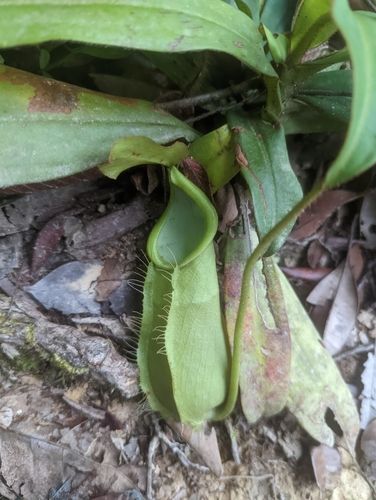
Etymology
- Nepenthes: see the genus sheet.
- hirsuta: from the Latin hirsutus, “bristly, hairy”.
History of the description
The English botanist Joseph Dalton Hooker described it in 1873, in Candolle's Prodromus.
Description (how to recognise it)
- The whole plant is covered in thick brown hairs, right up to the inflorescence; the stems bear dense long brown hairs.
- Pitchers mostly green, sometimes spotted with red on the inside.
Distribution
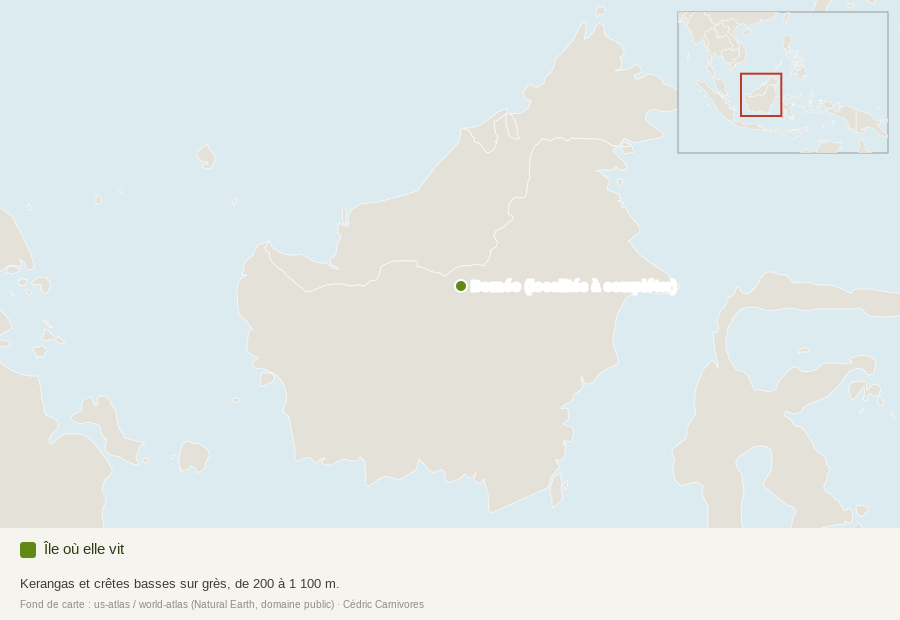
Endemic to Borneo, from 200 to 1,100 m.
Habitat
- Kerangas forest, mossy banks in lower montane forest, open places and disturbed vegetation on low ridges;
- mostly on sandstone.
Relationships
Close to N. hispida (which Jan Schlauer considers a synonym) and to N. macrovulgaris; some also link it to N. philippinensis from Palawan.
Natural hybrids
With N. albomarginata and N. ampullaria; perhaps with N. lowii (not confirmed).
Threats and protection
“Least concern” for the IUCN (2018).
Sources
- Wikipedia (English), Nepenthes hirsuta: Hooker 1873, synonym, etymology, description, range, altitude, habitat, relationships, hybrids, status.