Nepenthes hispida Beck
Species sheet, updated on 29/10/2026.
At a glance
| Scientific name | Nepenthes hispida Günther Beck, 1895 |
| Status of the name | Debated: sometimes included in N. hirsuta |
| Family | Nepenthaceae |
| Distribution | Northern Sarawak (Lambir Hills National Park) and Brunei |
| Habitat | Shady kerangas on steep sandstone ridges, from 100 to 800 m |
| Status | “Conservation dependent” (IUCN 2006, old criteria) |
Etymology
- Nepenthes: see the genus sheet.
- hispida: from the Latin hispidus, “bristling with stiff hairs”.
History of the description
- 1895: the Austrian botanist Günther Beck describes it.
- 1928: Danser merges it into N. hirsuta; 1997: Jebb and Cheek reinstate it. Intermediate forms suggest that the two are just the extremes of a single species.
Description (how to recognise it)
- Stems up to 6 m, covered in stiff, greyish-purple hairs, dense like bristles.
- Leaves: leathery, up to 28 cm by 4.
- Pitchers: rarely more than 15 cm; lower ones ovoid, upper ones more cylindrical; two narrow fringed wings, often absent on upper pitchers.
Distribution
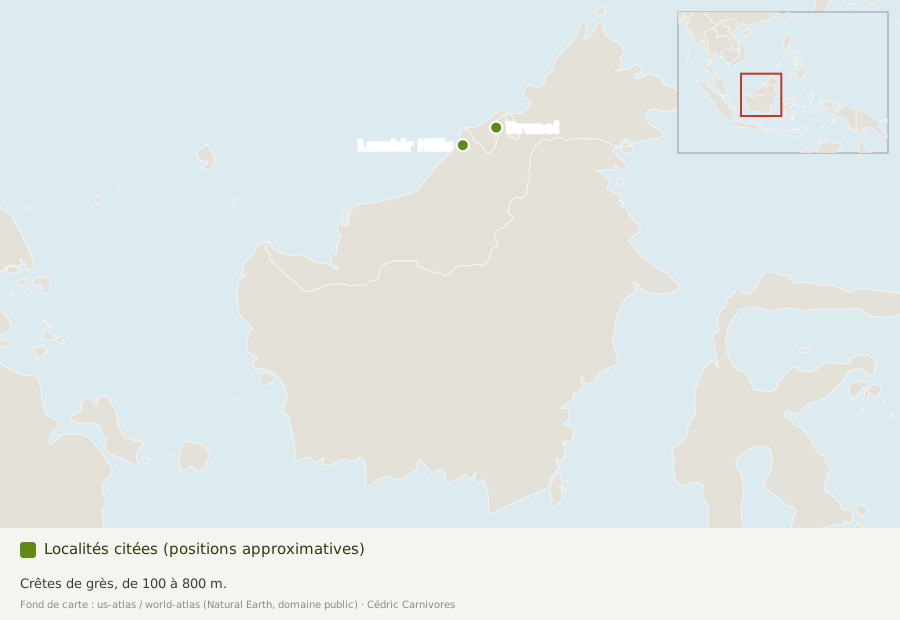
Endemic to Borneo: confirmed only in Lambir Hills National Park and its surroundings; also collected elsewhere in northern Sarawak and in Brunei. From 100 to 800 m.
Habitat
Shady kerangas forest on steep sandstone ridges, often with Eugeissona palms.
Relationships
Close to N. hirsuta; Jebb and Cheek also link it to N. philippinensis from Palawan.
Natural hybrids
Only with N. reinwardtiana.
Sources
- Wikipedia (English), Nepenthes hispida: Beck 1895, history of the name, description, range, altitude, habitat, relationships, hybrid, status.