Nepenthes holdenii Mey
Species sheet, updated on 30/10/2026.
At a glance
| Scientific name | Nepenthes holdenii François Mey et al., Carnivorous Plants and their Habitats vol. 2, 2010 |
| Family | Nepenthaceae |
| Distribution | Two sites in the Cardamom Mountains, Pursat Province (Cambodia) |
| Habitat | Transition between lowland and lower montane evergreen forest, from 600 to 800 m |
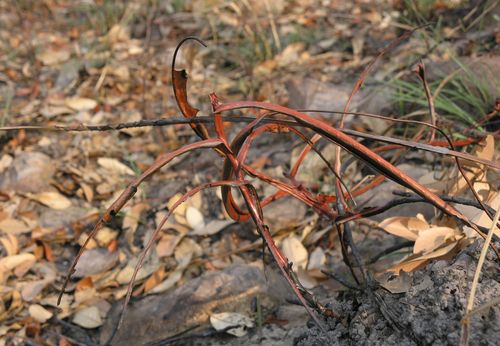
Photos in the wild
Etymology
- Nepenthes: see the genus sheet.
- holdenii: in honour of the biologist and photographer Jeremy Holden, who photographed it in 2006 (dedication, not confirmed).
History of the description
- 1909: Lecomte describes a specimen under the name N. thorelii.
- 2006: Jeremy Holden photographs the plant in the Cardamom Mountains.
- 2010: based on these photos, on observations and on the old specimen, François Mey separates it from N. thorelii.
- October 2011: a new population is reported; seeds collected in 2014 germinated in cultivation.
Description (how to recognise it)
- Linear leaves, 25 to 40 cm by 3.5 to 6.
- Pitchers up to 30 cm; long tendrils and round lower pitchers.
- Climbing stems up to 5 m in the rainy season; almost all the leaves and stems die back in the dry season.
Distribution
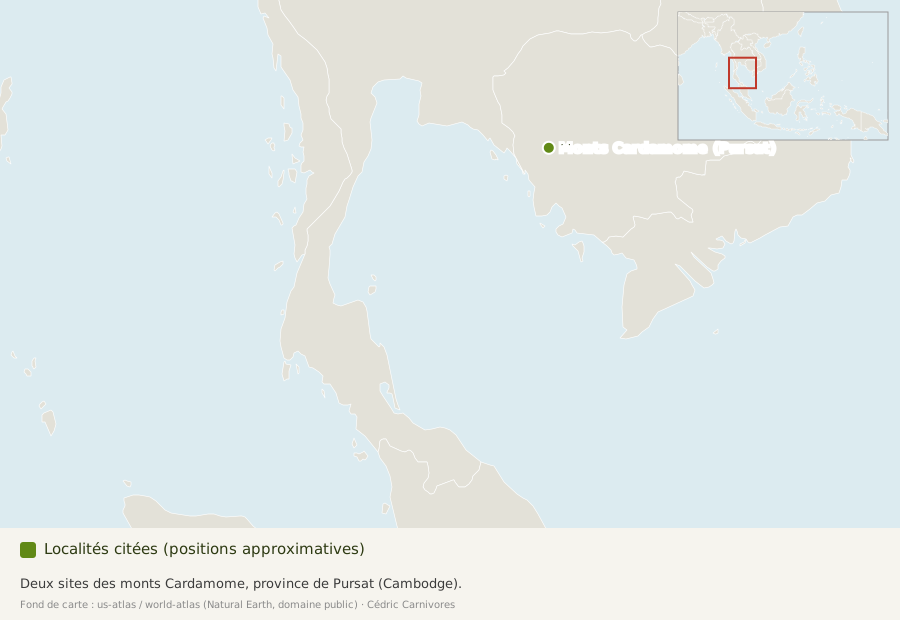
Endemic to Cambodia: two sites in the Cardamom Mountains (Phnom Kravanh, Pursat Province), from 600 to 800 m. Their exact location is kept secret to protect it.
Habitat
Transition zone between lowland and lower montane evergreen forest, under a monsoon climate with well-marked dry and wet seasons.
Ecology
A fire-adapted plant: it resprouts from its rootstock after dry-season fires. The nectar on the peristome attracts prey, which slip into the pitcher.
Did you know?
- It belongs to the N. thorelii group, with N. andamana, N. bokorensis, N. chang, N. kampotiana, N. kerrii, N. smilesii and N. suratensis.
Sources
- Wikipedia (English), Nepenthes holdenii: publication, Holden 2006, history, description, range, altitude, habitat, fire, N. thorelii group.