Nepenthes inermis Danser
Species sheet, updated on 29/10/2026.
At a glance
| Scientific name | Nepenthes inermis B. H. Danser, 1928 |
| Family | Nepenthaceae |
| Distribution | Barisan Mountains, West Sumatra and Jambi |
| Habitat | Mossy forest (on trees) and stunted upper montane vegetation, from 1,500 to 2,600 m |
| Status | Least concern (IUCN, 2018) |
Etymology
- Nepenthes: see the genus sheet.
- inermis: a Latin word meaning “unarmed”, because its upper pitchers have no peristome, the toothed rim of other Nepenthes.
History of the description
- 7 September 1918: H. A. B. Bünnemeijer collects it on Mount Talang, at 2,590 m, then on Bukit Gombak (November 1918) and Mount Kerinci (26 April 1920, 1,800 m). The Kerinci specimen was designated as the reference in 1997.
- The labels bear names in the Minangkabau language: galoe-galoe antoe and kandjong baroek, whose meaning Danser could not find.
- 1927: first illustration in De Tropische Natuur; 1928: description by Danser.
- Several authors later included it in N. bongso.
Description (how to recognise it)
- A climber up to 7 m, with thin stems, often purplish red.
- Leaves: leathery, spatulate, up to 12 cm by 3, green with an often red midrib.
- Lower pitchers: rare, up to 8 cm.
- Upper pitchers: larger, up to 9 cm by 5, widely flared like a funnel, yellow-green.
- No peristome on adult upper pitchers: a feature unique in the genus.
- Lid very long and narrow, wedge-shaped, never rising beyond 90°.
Distribution
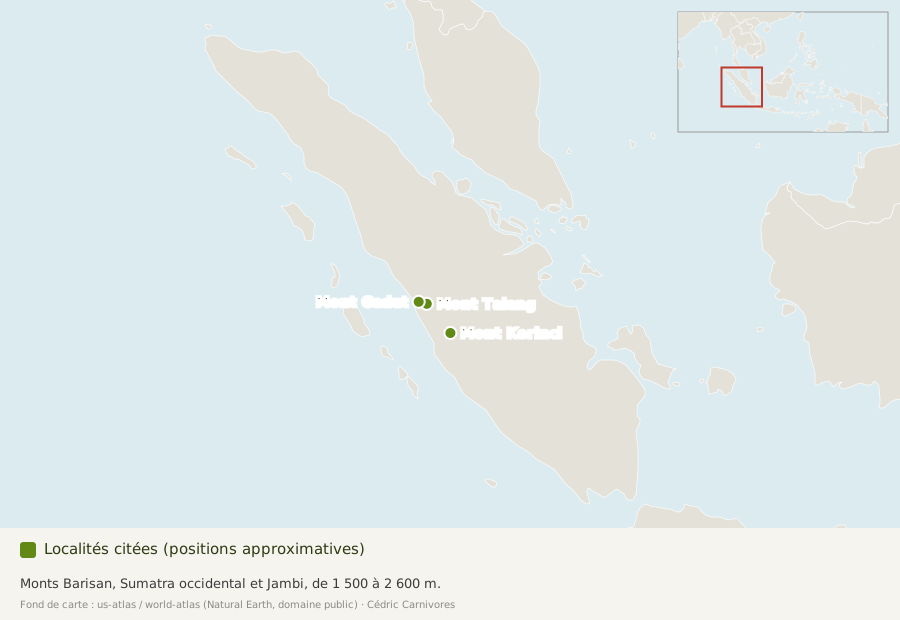
Endemic to the Barisan Mountains, in the provinces of West Sumatra and Jambi: large populations on Mount Talang, Mount Gadut and Mount Belirang; also on Mount Gadang. From 1,500 to 2,600 m.
Habitat
- Usually on trees, in mossy forest;
- on the ground in stunted upper montane vegetation, above 2,000 m.
Ecology: glue in the pitcher
- Its fluid is extremely viscous: when poured, it forms a continuous thread several metres long.
- The pitcher is both a pitfall trap and flypaper: flying insects stick to the walls, then slide into the fluid.
- Prey: mostly flies and midges. The pitchers generally host no inhabitants.
- In heavy rain, the upper pitchers tip over, empty out the rainwater but keep their sticky fluid, then right themselves.
Relationships
It belongs to a group of species from the mountains of Sumatra (N. dubia, N. flava, N. jacquelineae, N. jamban, N. talangensis, N. tenuis). Its closest relative is N. dubia, which has a peristome and yellow to orange pitchers. Kurata linked it to N. campanulata from Borneo, which other botanists dispute.
Natural hybrids
- N. × pyriformis (with N. talangensis): on the upper part of Mount Talang, where both parents grow together. Kurata had described it as a species in 2001.
- With N. singalana and N. spathulata, where their ranges overlap.
Threats and protection
“Least concern” for the IUCN (C. M. Clarke, 2018).
Sources
- Wikipedia (English), Nepenthes inermis: Danser 1928, Bünnemeijer's collections, Minangkabau names, description, absence of peristome, range, altitude, habitat, viscous fluid, prey, tipping pitchers, relationships, hybrids, status.