Nepenthes jacquelineae C. Clarke, Troy Davis & Tamin
Species sheet, updated on 29/10/2026.
At a glance
| Scientific name | Nepenthes jacquelineae Charles Clarke, Troy Davis & Rusjdi Tamin, 2001 |
| Family | Nepenthaceae |
| Distribution | Barisan Mountains, West Sumatra |
| Habitat | Dense, cool and misty mossy forest, from 1,700 to 2,200 m |
| Status | Not assessed by the IUCN; “data deficient” according to Clarke (2001) |
Etymology
- Nepenthes: see the genus sheet.
- jacquelineae: in honour of Jacqueline, the wife of the botanist Charles Clarke.
History of the discovery
- July 2000: Charles Clarke and Troy Davis discover it north of Bukittinggi, in West Sumatra, at around 1,700 m. The reference specimen, collected on 13 July 2000, is kept at the herbarium of Andalas University.
- 2001: it is described in Clarke's book, Nepenthes of Sumatra and Peninsular Malaysia.
Description (how to recognise it)
- A climber with stems up to 5 m.
- Spectacular upper pitchers: up to 15 cm tall and 10 cm wide, with a huge peristome, up to 3.5 cm wide, broadly flared.
- Lower pitchers: smaller, rarely more than 6 cm.
- Colours: from light green to dark purple. The most common form has green pitchers with a red peristome.
Distribution
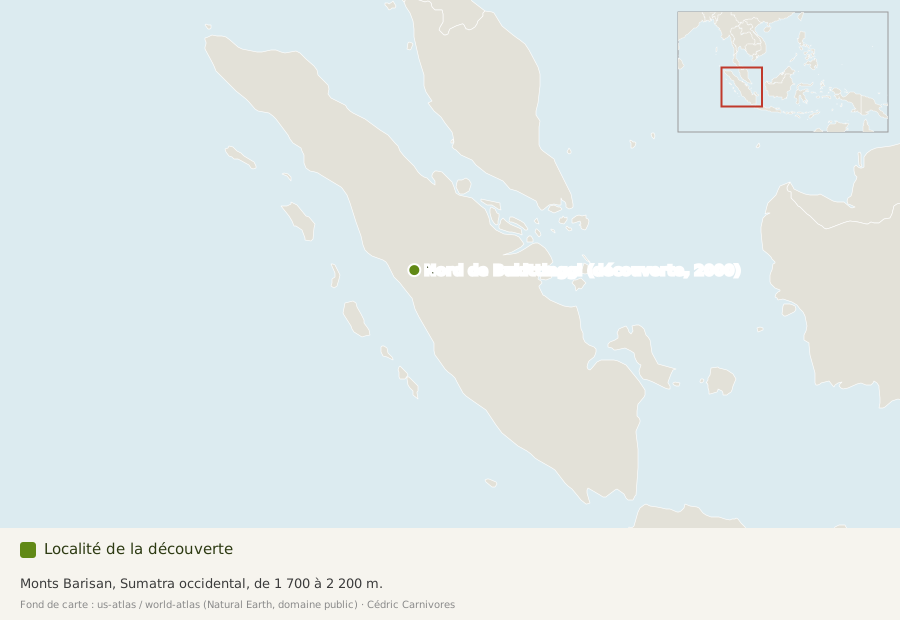
Endemic to the Barisan Mountains, in West Sumatra (Indonesia), from 1,700 to 2,200 m.
Habitat
- Dense mossy forest, often misty, cool, damp and dark;
- usually on trees (as an epiphyte), sometimes on the ground.
Natural hybrids
- With N. izumiae, which grows alongside it: reddish hybrids that mostly resemble N. jacquelineae.
- Perhaps also with N. dubia.
Threats and protection
It is not on the IUCN Red List. In 2001 Clarke considered it “data deficient”. Its beauty makes it vulnerable to collection.
Did you know?
- Discovered in July 2000, it was dedicated to the wife of its discoverer.
Sources
- Wikipedia (English), Nepenthes jacquelineae: Clarke, Davis & Tamin 2001, discovery in 2000, etymology, description, range, altitude, habitat, hybrids, status.