Nepenthes junghuhnii Macfarl.
Species sheet, updated on 30/10/2026. Short sheet: sources on this species are still scarce.
At a glance
| Scientific name | Nepenthes junghuhnii John Muirhead Macfarlane ex Henry Ridley, 1917 (name not validly published) |
| Family | Nepenthaceae |
| Distribution | Batak lands near Lake Toba (North Sumatra); Mount Kerinci (Jambi), according to Ridley |
| Status | Doubtful species, never seen again |
Etymology
- Nepenthes: see the genus sheet.
- junghuhnii: in honour of the explorer Franz Wilhelm Junghuhn, who collected it between 1840 and 1842.
History of the description
- 1840-1842: Junghuhn collects specimens in the Batak lands, near Lake Toba.
- 27 April 1914: H. E. Robinson and C. B. Kloss collect on Mount Kerinci the plants that Ridley published under this name in 1917.
- Macfarlane's name had no description, and Ridley's was not in Latin: Danser considered it not valid.
Description (how to recognise it)
- Clearly petiolate leaves.
Distribution
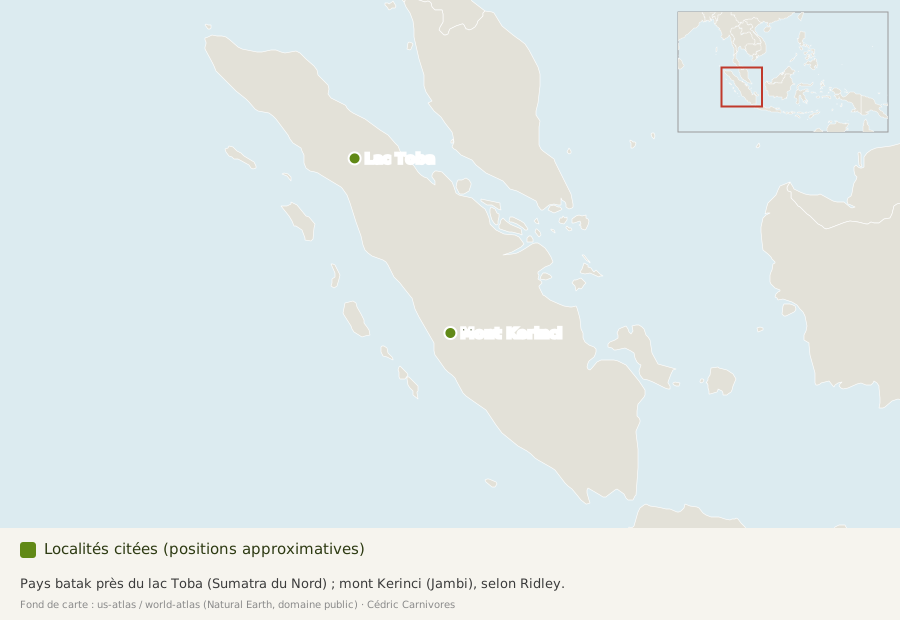
Batak lands, near Lake Toba (North Sumatra); the plants from Mount Kerinci (Jambi) described by Ridley are in fact N. singalana. Kew treats it as a synonym of Nepenthes singalana.
Did you know?
- It has never been found again since. Jan Schlauer sees it as a “rather doubtful species” and perhaps a form of N. bongso; it also resembles N. spathulata.
- Danser thought of a hybrid N. singalana × N. sanguinea, but we now know that N. sanguinea does not occur in Sumatra.
Sources
- Wikipedia (English), Nepenthes junghuhnii: authors, validity of the name, etymology, collections, leaves, synonymies, hypotheses.
- Kew, World Checklist of Vascular Plants (via GBIF): natural distribution, status of the name.