Nepenthes kerrii M. Catal. & Kruetr.
Species sheet, updated on 30/10/2026.
At a glance
| Scientific name | Nepenthes kerrii Marcello Catalano & Trongtham Kruetreepradit, Nepenthes della Thailandia, 2010 |
| Family | Nepenthaceae |
| Distribution | Tarutao National Marine Park, Satun Province (southern Thailand) |
| Habitat | Savannas and grasslands on quartz sand over granite, from 400 to 500 m |
| Status | Least concern (IUCN, 2018) |
Etymology
- Nepenthes: see the genus sheet.
- kerrii: in honour of the Irish physician Arthur Francis George Kerr, who made the first collection of it in 1928.
History of the description
- 1928: Kerr collects it; his specimen will become the type.
- 2006: Marcello Catalano rediscovers this specimen and recognises a new species in it.
- 2008: park rangers find the plants again; Stewart McPherson reaches them, and in 2009 mentions it as “N. sp. Trang”.
- 2010: description.
Description (how to recognise it)
- A climber up to 4 m, with an unbranched stem.
- Oval lower pitchers, up to 14 by 6 cm, usually orange spotted with red.
- Tubular upper pitchers, up to 15 by 3.5 cm, green to yellow, with a lobed, often striped peristome.
- Inflorescence up to 130 cm.
Distribution
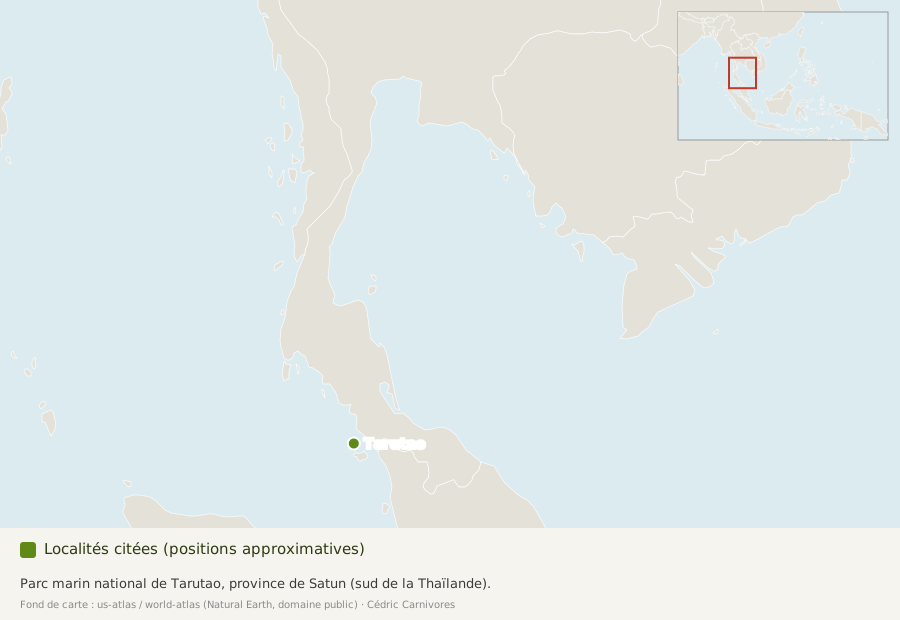
Endemic to southern Thailand: Tarutao National Marine Park (Satun Province), from 400 to 500 m. The plants from the Malaysian island of Langkawi, formerly included in it, were described in 2024 as N. ridzaiana.
Habitat
Savannas and open grasslands, on quartz-rich sand over granite.
Ecology
No other Nepenthes grows with it; no natural hybrid known.
Threats and protection
According to McPherson, its populations are “extremely difficult to access” and not threatened for now.
Did you know?
- Its closest relative is N. kongkandana.
Sources
- Wikipedia (English), Nepenthes kerrii: publication, etymology, history, description, range, altitude, habitat, status, relationships, N. ridzaiana.