Nepenthes klossii Ridl.
Species sheet, updated on 29/10/2026.
At a glance
| Scientific name | Nepenthes klossii Henry Nicholas Ridley, Transactions of the Linnean Society of London, August 1916 |
| Family | Nepenthaceae |
| Distribution | Papua Province, Indonesian New Guinea |
| Habitat | Montane swamp forest, sometimes grassland, from about 930 to 2,000 m |
| Status | Endangered (IUCN, 2000 assessment) |
Etymology
- Nepenthes: see the genus sheet.
- klossii: in honour of the zoologist Cecil Boden Kloss, who first collected it in 1913.
History of the discovery
- 26 January 1913: during the Wollaston expedition (1912-1913) in south-western New Guinea, Kloss collects it near camp VIb, between 930 and 1,170 m. The specimen, without flowers, is kept at the herbarium of the Singapore Botanic Gardens.
- 1916: Ridley describes it in the expedition report… mixing up the upper and lower sides of the leaves.
- 1928: Danser corrects the description.
- 1991: Matthew Jebb's monograph finally describes the hood shape of its pitchers.
Description (how to recognise it)
- A climber that climbs several metres.
- Leaves: leathery, up to 25 by 9 cm, covered underneath with dense golden hairs.
- Upper pitchers: narrowly funnel-shaped, up to 26 cm, with a mouth placed on the side, under a dome: the pitcher forms a kind of hood.
- Colours: pitchers speckled with red, with a purple lid.
Distribution
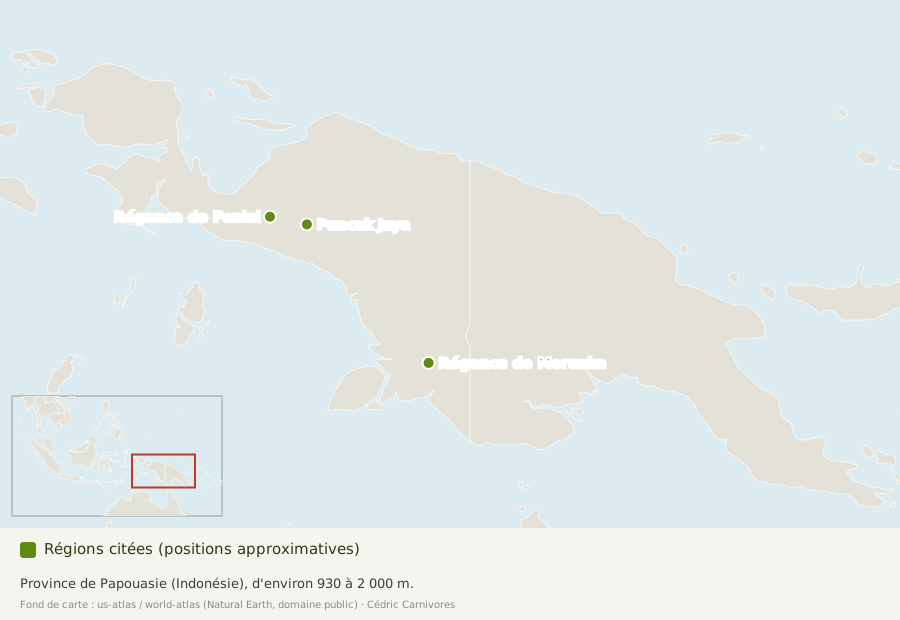
Endemic to Papua Province (Indonesia): Merauke and Paniai regencies, and the lower slopes of Puncak Jaya. From about 930 to 2,000 m.
Habitat
Montane swamp forest, sometimes grassland.
Ecology: a pitcher with windows
It is one of only two Nepenthes whose pitcher dome bears pale patches that let light through, along with N. aristolochioides from Sumatra. This light may attract flying insects, which make up most of its prey; the mechanism has not yet been well studied.
Relationships
Danser placed it near N. veitchii, N. stenophylla and N. fusca (section Regiae). It belongs to the maxima complex.
Natural hybrids
Presumed hybrids with a dwarf form of N. maxima, at a site at around 1,700 m.
Threats and protection
- “Endangered” for the IUCN.
- Extremely rare: the most accessible population was threatened by a road under construction in March 2009, and the hybrid site was due to be cleared. Some populations have not been seen again for decades.
Sources
- Wikipedia (English), Nepenthes klossii: Ridley 1916, Wollaston expedition, Kloss 1913, specimen, Danser 1928, Jebb 1991, description, range, altitude, habitat, windowed pitchers, relationships, hybrids, status, threats.