Nepenthes lamii Jebb & Cheek
Species sheet, updated on 30/10/2026.
At a glance
| Scientific name | Nepenthes lamii Matthew Jebb & Martin Cheek, Blumea 42, 1997 |
| Family | Nepenthaceae |
| Distribution | Central Papua Province (Indonesian New Guinea) |
| Habitat | Forests, scrub, grasslands and high-altitude heath, from 1,460 to 3,520 m |
| Status | Least concern (IUCN, 2014) |
Etymology
- Nepenthes: see the genus sheet.
- lamii: in honour of the Dutch botanist Herman Johannes Lam, who made one of the first collections.
History of the description
- October 1920: Lam collects it on Doorman Top (now Mount Anggemuk) during the Van Overeem expedition.
- 1928: Danser includes it in N. vieillardii from New Caledonia.
- 1997: description as a species; in 2011, N. monticola, which had been included in it, is separated from it.
Description (how to recognise it)
- A climbing or bushy plant up to 4 m, dwarf at high altitude.
- Leaves up to 22 by 5 cm; almost hairless.
- Reddish lower pitchers, ovate-cylindrical.
- Funnel-shaped upper pitchers, up to 18 by 5 cm.
- Round lid, covered with very densely packed nectar glands.
Distribution
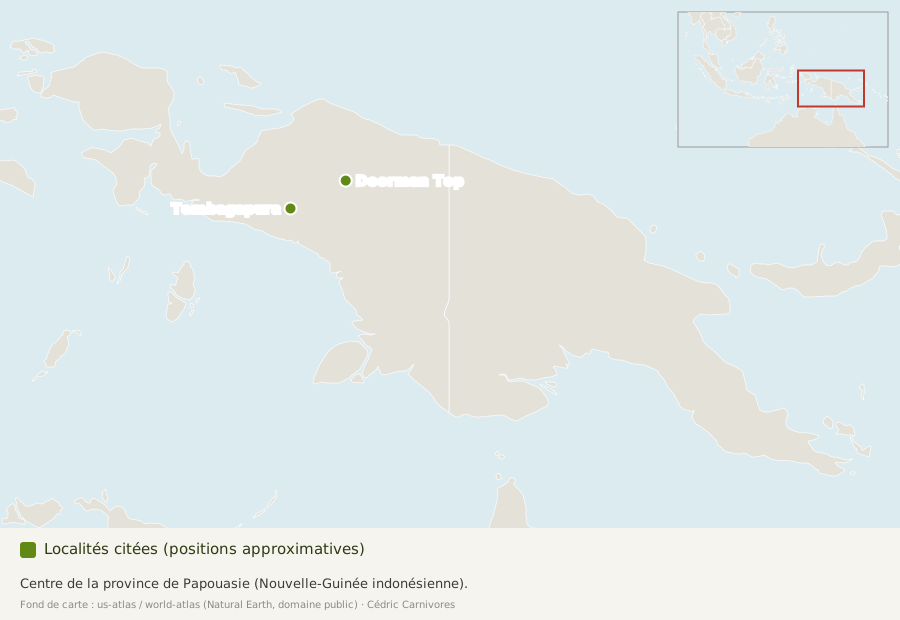
Endemic to New Guinea: central Papua Province, including Doorman Top, Mount Erica (Hellwig Mountains) and large populations near Tembagapura. From 1,460 to 3,520 m.
Habitat
- Lower down, it climbs in forest and scrub.
- At altitude, stunted plants on the ground, among scrub, grasses or heath, where nights come close to or drop below freezing.
Natural hybrids
None known, although N. maxima also grows on Doorman Top.
Did you know?
- 3,520 m: this is the highest altitude ever recorded for a Nepenthes.
- Its pitchers recall those of N. murudensis and of the large N. tentaculata from Borneo.
Sources
- Wikipedia (English), Nepenthes lamii: publication, etymology, history, description, range, record altitude, habitat, frost, hybrids, status, relationships.