Nepenthes leonardoi S. McPherson et al.
Species sheet, updated on 29/10/2026.
At a glance
| Scientific name | Nepenthes leonardoi S. McPherson, Bourke, Cervancia, Jaunzems & A. S. Rob., Carniflora Australis, March 2011 |
| Status of the name | Treated as a synonym of N. deaniana in Jan Schlauer's database |
| Family | Nepenthaceae |
| Distribution | Schom-carp Peak, central Palawan (Philippines) |
| Habitat | High-mountain forest and thicket, from 1,300 to 1,490 m |
| Status | Least concern according to the IUCN (2014), “critically endangered” according to its describers |
Etymology
- Nepenthes: see the genus sheet.
- leonardoi: in tribute to the Filipino botanist Leonardo Co, killed on 15 November 2010 on the island of Leyte, caught in crossfire between the army and a guerrilla group. It was the first day of the expedition that would discover the plant.
History of the discovery
- 18 November 2010: Greg Bourke, Jehson Cervancia, Mark Jaunzems and Stewart McPherson discover it; they first call it “Nepenthes sp. Palawan”.
- 20 November 2010: the reference specimen is collected near the summit of Schom-carp Peak, at 1,490 m (herbarium of Palawan State University, in Puerto Princesa).
- 2011: description.
Description (how to recognise it)
- A climbing or creeping plant, with stems up to 4 m.
- Leaves: leathery, up to 50 cm; green in the shade, red to purple in the sun. The tendrils sometimes exceed 1.30 m.
- Lower pitchers: egg- or urn-shaped, up to 15 cm, orange to red, often speckled with purple.
- Upper pitchers: funnel-shaped, up to 24 cm, usually green-yellow with an orange to red peristome, but sometimes entirely burgundy, or even almost black. This black comes from a dark purple pigment combined with brown hairs.
- Scented male flowers, with a “sweet musty” smell.
Distribution
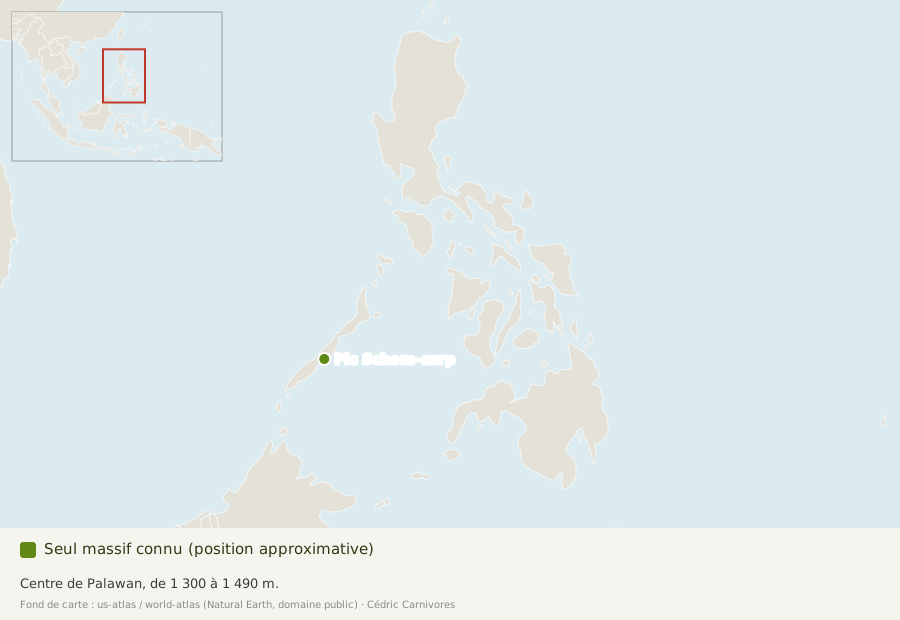
Known from a single massif in central Palawan: Schom-carp Peak (also called Shumkat) and its east ridge, towards the municipality of Narra. From at least 1,300 m to the summit (1,490 m). The only known population numbers several thousand plants.
Habitat
- On the ground, in forest and high-mountain thicket;
- it seems to be displaced by bamboo: it is almost absent from the highest parts of the east ridge;
- no other Nepenthes grows with it.
Ecology
Its pitchers host small spiders and mosquito larvae.
Relationships
Close to the other Palawan endemics: N. deaniana, N. gantungensis and N. mira. For some authors, it is only a form of N. deaniana.
Natural hybrids
None known.
Threats and protection
- The describers proposed listing it as “critically endangered” (a single population); the IUCN assessed it as least concern (Clarke and Lee, 2014).
- The habitat is intact, but mines to the south, on the Mount Victoria massif, could threaten it.
Did you know?
- Its describers presented it as the only Nepenthes in the Philippines known for its black pitchers.
Sources
- Wikipedia (English), Nepenthes leonardoi: 2011 description, synonymy (Schlauer), Leonardo Co, discovery, specimen, description, colours, range, population, habitat, bamboo, pitcher fauna, status, threats.