Nepenthes leyte Jebb & Cheek
Species sheet, updated on 30/10/2026.
At a glance
| Scientific name | Nepenthes leyte Matthew Jebb & Martin Cheek, European Journal of Taxonomy 69, 2013 |
| Family | Nepenthaceae |
| Distribution | Leyte Island (Philippines) |
| Habitat | Mid-montane mossy forest, at around 900 m |
Etymology
- Nepenthes: see the genus sheet.
- leyte: from the island of Leyte.
Description (how to recognise it)
- N. alata group: winged petioles, ridges under the lid, upper pitchers wider towards the bottom.
- A terrestrial climber of about 2 m, with a hairless stem except in the leaf axils (branched white hairs); upper pitchers without fringed wings, with star-shaped hairs on the outer surface.
- It differs from N. alata (very hairy stems) and from N. graciliflora, the only other species on Leyte, especially in the nectar glands of the lid, which are of two sizes and concentrated on the margin and the appendage.
Distribution
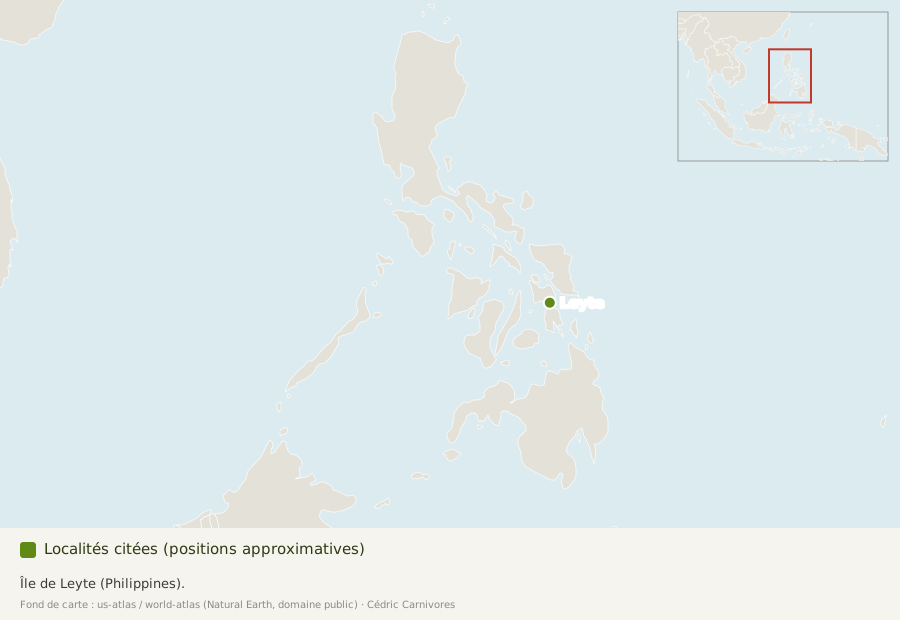
Endemic to Leyte Island, at around 900 m.
Habitat
Mid-montane mossy forest. “Climbing on a fallen tree in submontane mossy forest”, at around 900 m, on Mount Lobi near Dagami (Leyte Island, volcanic); known from a single plant (1999), outside any protected area: “critically endangered”.
Did you know?
- Gronemeyer et al. (2016) think it may be only a form of N. ramos; field studies would be needed to settle the question.
Sources
- Wikipedia (English), Nepenthes leyte: publication, etymology, range, altitude, habitat, N. alata group, link with N. ramos.
- “Recircumscription of the Nepenthes alata group in the Philippines, with four new species” (Plazi text, public domain, via GBIF): original description, habitat, conservation.
- GBIF, Nepenthes leyte: author, original publication, countries and localities of herbarium specimens and observations.