Nepenthes lingulata Chi. C. Lee, Hernawati & Akhriadi
Species sheet, updated on 29/10/2026.
At a glance
| Scientific name | Nepenthes lingulata Ch'ien C. Lee, Hernawati & Pitra Akhriadi, Blumea, 2006 |
| Family | Nepenthaceae |
| Distribution | Barisan Mountains, south of Padang Sidempuan (North Sumatra) |
| Habitat | High-mountain mossy forest, from about 1,700 to 2,100 m |
| Status | Not assessed |
Etymology
- Nepenthes: see the genus sheet.
- lingulata: from the Latin lingula, “little tongue”, for the appendage that hangs from its lid.
History of the discovery
It was discovered during the same trips as N. jamban, in 2004-2005. First collection on 22 April 2005, south of Padang Sidempuan; specimen at Andalas University; description in 2006.
Description (how to recognise it)
- A climber up to about 8 m.
- Lower pitchers: up to about 28 by 4.5 cm; upper pitchers: smaller, about 12 cm.
- Colours: dark purple to black outside, pale blue-green spotted with purple inside.
- The “tongue”: a single filament, up to 4 cm, hangs from the lid above the mouth. Its tip bears nectar glands, whereas the rest of the lid's underside has none. It probably lures insects above the opening, where they slip.
- Triangular lid, up to 7.5 cm.
Distribution
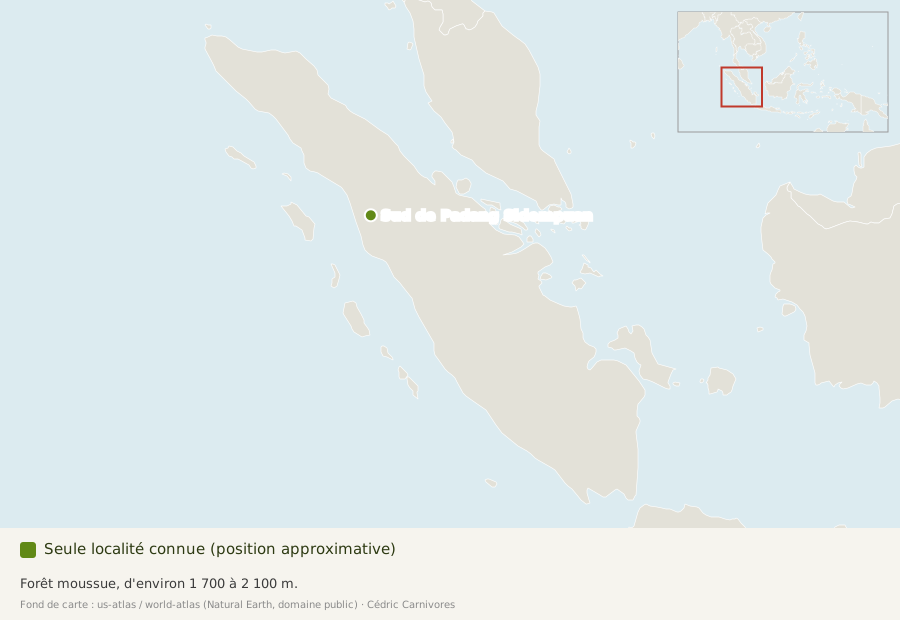
Endemic to the Barisan Mountains, in northern Sumatra: known only from its type locality. From about 1,700 to 2,100 m.
Habitat
High-mountain mossy forest, on the ground and on trees, with N. bongso, N. dubia, N. gymnamphora and N. jamban.
Relationships
Close to N. izumiae, from which it is distinguished by its triangular lid and its long “tongue”.
Natural hybrids
With N. jamban.
Sources
- Wikipedia (English), Nepenthes lingulata: 2006 description, discovery 2004-2005, etymology, description, colours, nectar appendage, range, altitude, habitat, relationships, hybrid.