Nepenthes longifolia Nerz & Wistuba
Species sheet, updated on 29/10/2026.
At a glance
| Scientific name | Nepenthes longifolia Joachim Nerz & Andreas Wistuba, Carnivorous Plant Newsletter, 1994 |
| Family | Nepenthaceae |
| Distribution | West Sumatra (perhaps North Sumatra) |
| Habitat | Dense, shady forest on sandstone slopes and ridges, from 300 to 1,100 m |
| Status | Least concern (IUCN, 2018) |
Etymology
- Nepenthes: see the genus sheet.
- longifolia: from the Latin longus, “long”, and folium, “leaf”, for its exceptionally large leaves.
History of the description
- 1957: Willem Meijer collects it near Taram, in West Sumatra, together with N. tenuis and N. adnata.
- 1992: Nerz collects the reference specimen in the Tjampo Mountains; description in 1994.
- Jebb and Cheek include it in N. sumatrana (1997, 2001); Clarke reinstates it in 2001.
Description (how to recognise it)
- A vigorous climber: stems often 10 m, up to 12 m.
- Leaves: up to 55 by 9 cm.
- Very long rosette tendrils, up to 1.10 m: this is what distinguishes it from N. sumatrana.
- Lower pitchers: up to 20 cm, red-brown; upper pitchers: up to 25 cm, entirely light green.
Distribution
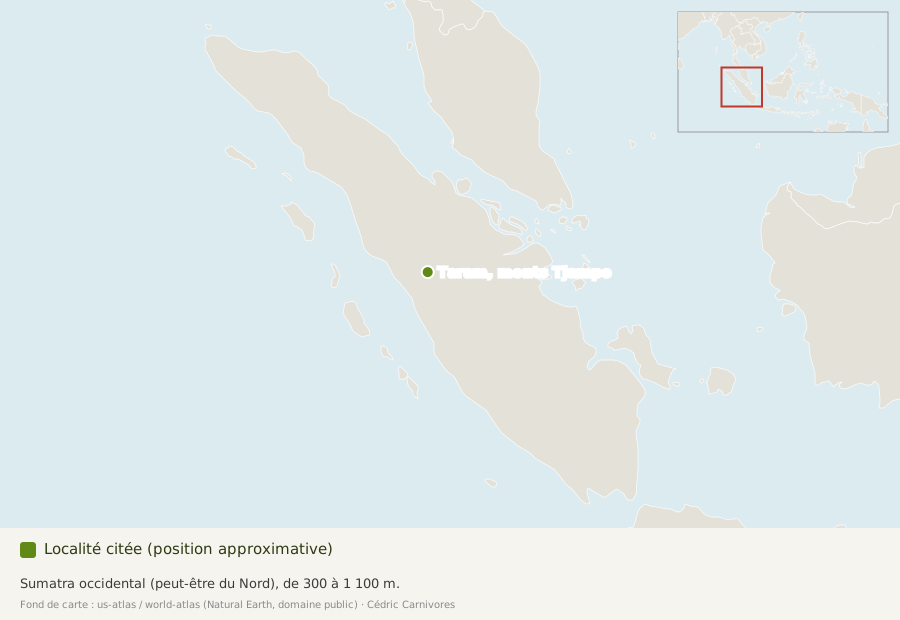
West Sumatra, perhaps also North Sumatra. From 300 to 1,100 m.
Habitat
On the ground, in dense, shady lowland or submontane forest, on steep sandstone slopes and ridges.
Natural hybrids
Rare: certainly with N. eustachya; perhaps with N. sumatrana.
Threats and protection
“Least concern” for the IUCN (2018). In 2001 Clarke proposed “vulnerable”, because of fires lit for agriculture.
Sources
- Wikipedia (English), Nepenthes longifolia: Nerz & Wistuba 1994, Meijer 1957, 1992 specimen, etymology, description, tendrils, range, altitude, habitat, hybrids, status, history of the name.
- Wikipedia (English), Nepenthes tenuis: Meijer's joint collection.