Nepenthes lowii Hook. f.
Species sheet, updated on 29/10/2026.
At a glance
| Scientific name | Nepenthes lowii Joseph Dalton Hooker, Transactions of the Linnean Society of London, 1859 |
| Family | Nepenthaceae |
| Common names | Low's pitcher plant; in French népenthès de Low |
| Distribution | Isolated summits of Borneo (Sabah, Sarawak, Brunei) |
| Habitat | Montane mossy forest, low ridge-top vegetation, from 1,650 to 2,600 m |
| Status | Vulnerable (IUCN) |
Photos in the wild
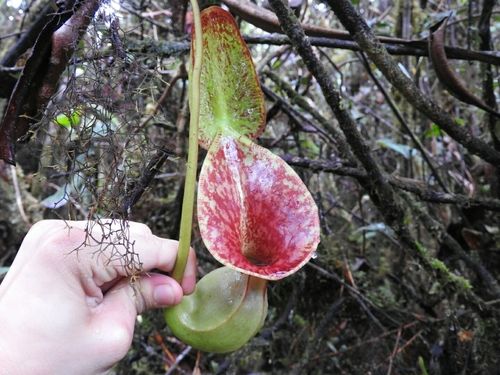
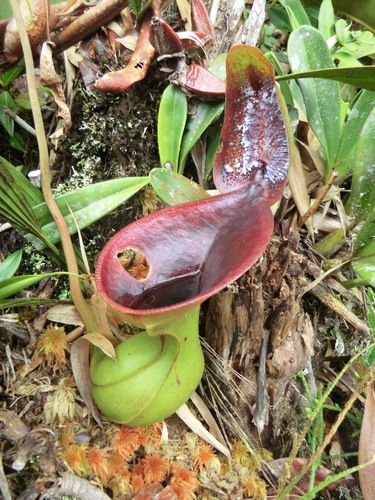
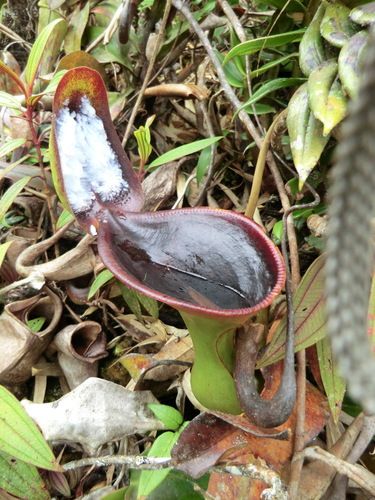
Etymology
- Nepenthes: see the genus sheet.
- lowii: in honour of Hugh Low, British colonial administrator and naturalist, who discovered it.
History of the discovery
- March 1851: Hugh Low discovers it during his first ascent of Mount Kinabalu.
- 1859: Joseph Dalton Hooker describes it.
Description (how to recognise it)
- Habit: a climbing plant, with stems over 10 m long and up to 2 cm in diameter; leathery leaves up to 30 cm.
- Unique upper pitchers: swollen into a ball at the base, strongly constricted in the middle, then flaring into a funnel. They are up to 28 cm tall and 10 cm wide, and exceptionally rigid.
- The peristome is reduced to simple ribs.
- The lid is bent backwards, and its underside bears bristles up to 2 cm long, which secrete a white substance. This was long thought to be snail eggs: it is in fact a secretion of the plant.
- Lower pitchers: smaller and bulbous (about 10 by 4 cm), with a true toothed and ribbed peristome, and they too have bristles under the lid.
Distribution
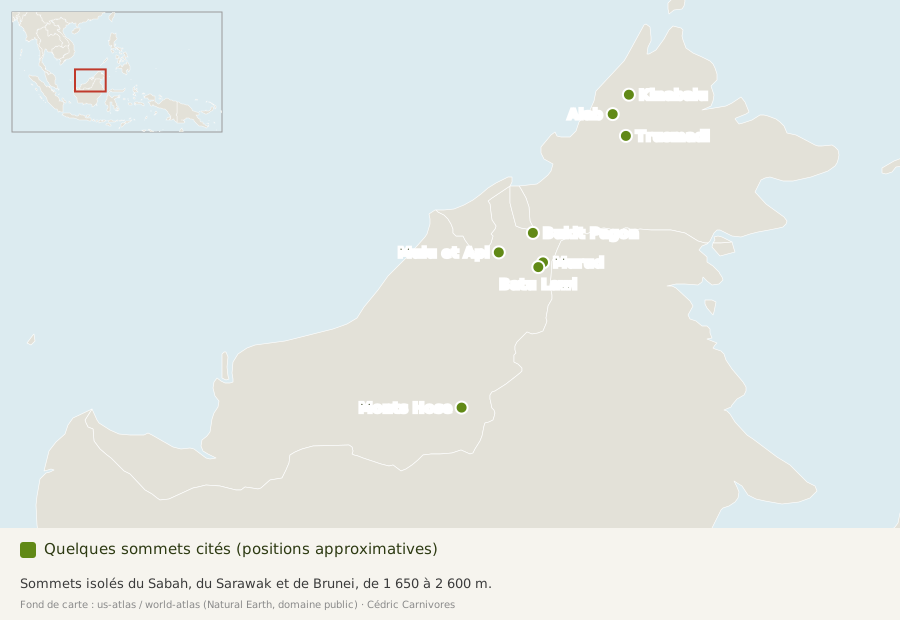
Endemic to isolated summits of Borneo, from 1,650 to 2,600 m altitude:
- Sabah: Kinabalu, Tambuyukon, Alab, Mentapok, Monkobo, Trusmadi;
- Sarawak: Api, Buli, Mulu, Murud, Batu Lawi, Batu Tiban, Hose Mountains, Tama Abu Range, Bario;
- Brunei: Bukit Pagon.
Habitat
- Montane mossy forest and stunted ridge-top vegetation;
- poor soils, often on a carpet of moss;
- it grows on the ground or on trees (as an epiphyte).
Ecology: a toilet for treeshrews
- Few insects: its pitchers catch few insects compared with other Nepenthes.
- Droppings instead: mountain treeshrews (Tupaia montana), and some birds, come to lick the sugary secretions of the lid. Sitting on the pitcher, they defecate into it.
- A 2009 study (Clarke and colleagues) showed that adult plants obtain 57 to 100% of the nitrogen in their leaves from treeshrew droppings.
- A made-to-measure pitcher: in 2010, another study (Chin, Moran and Clarke) showed that the opening of the pitcher matches exactly the size of the mountain treeshrew.
Natural hybrids
At least seven are known:
| Hybrid | Other parent |
|---|---|
| N. × trusmadiensis | N. macrophylla (Mount Trusmadi) |
| unnamed, known as the “Mentapok Nepenthes” | N. stenophylla |
| unnamed | N. fusca, N. hurrelliana, N. muluensis, N. veitchii; a single plant known with N. rajah |
Threats and protection
- “Vulnerable” for the IUCN (2000 assessment, published in 2006). The specialist Charles Clarke considered it rather “conservation dependent”, as many populations are in protected areas.
- Along the summit trail of Kinabalu, populations declined after the 1997-1998 El Niño event and because of damage caused by hikers.
Did you know?
- It feeds mainly on droppings: its pitchers serve as toilets for treeshrews.
- The white “cream” under its lid, once taken for snail eggs, is a bait the plant produces itself.
Sources
- Wikipedia (English), Nepenthes lowii: Hooker 1859, discovery in 1851, description, range and summits, altitude, habitat, treeshrews, hybrids, statuses; references: Clarke et al. 2009, Biology Letters; Chin, Moran & Clarke 2010, New Phytologist; Clarke 1997, Nepenthes of Borneo; Phillipps & Lamb 1996, Pitcher-Plants of Borneo.