Nepenthes macrovulgaris Turnbull & Middleton
Species sheet, updated on 29/10/2026.
At a glance
| Scientific name | Nepenthes macrovulgaris J. R. Turnbull & A. T. Middleton, Botanical Journal of the Linnean Society, 1988 |
| Common name | “Serpentine Nepenthes”; in French népenthès des serpentines |
| Family | Nepenthaceae |
| Distribution | Ultramafic soils of Sabah (Malaysian Borneo) |
| Habitat | Clearings in submontane forest and mossy forest, usually from 300 to 1,200 m |
| Status | Least concern (IUCN, 2018) |
Photos in the wild
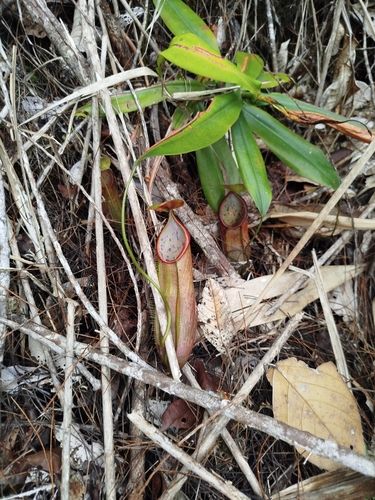

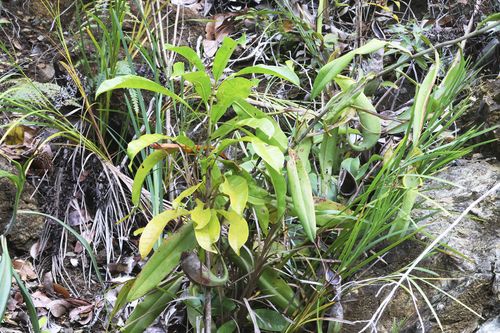
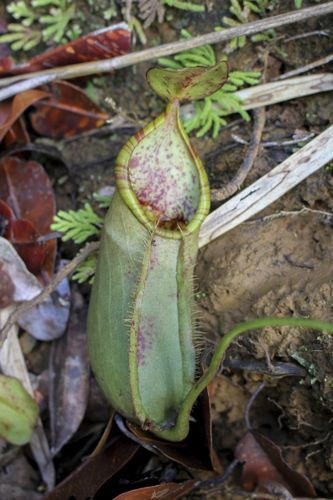
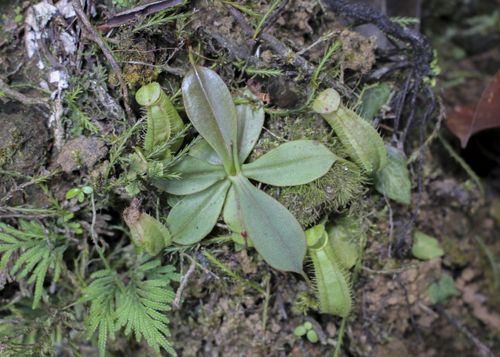
Etymology
- Nepenthes: see the genus sheet.
- macrovulgaris: from the Greek macro-, “large”, and the Latin vulgaris, “common”. The describers point out that this suffix does not mean that the species is common or ordinary (exact intended meaning; probably “large N. vulgaris”, an old name, not confirmed).
Description (how to recognise it)
- Pitchers: up to about 25 cm, from green to brown; the speckled form is the most common.
Distribution
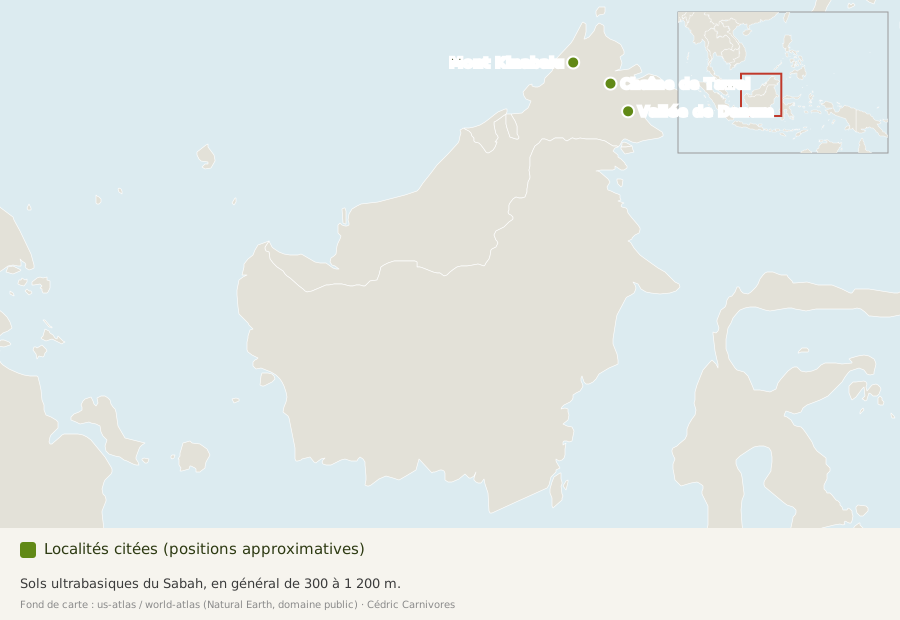
Only on the ultramafic soils of Sabah: Mount Kinabalu, Mount Tambuyukon, Danum Valley, the Tawai and Meliau ranges, Mount Silam.
Habitat
- Clearings in submontane forest and mossy forest, usually from 300 to 1,200 m;
- a form with narrow pitchers grows between 100 and 150 m.
Relationships
Genetic studies place it next to N. reinwardtiana. It was formerly linked to N. hirsuta and N. hispida; it also resembles N. philippinensis from Palawan.
Natural hybrids
With N. albomarginata, N. rajah, N. reinwardtiana and N. tentaculata.
Threats and protection
“Least concern” for the IUCN (2018).
Sources
- Wikipedia (English), Nepenthes macrovulgaris: Turnbull & Middleton 1988, etymology, description, range, altitude, ultramafic habitat, relationships, hybrids, status.