Nepenthes mantalingajanensis Nerz & Wistuba
Species sheet, updated on 30/10/2026.
At a glance
| Scientific name | Nepenthes mantalingajanensis Joachim Nerz & Andreas Wistuba, Das Taublatt, 2007 |
| Family | Nepenthaceae |
| Distribution | Summit of Mount Mantalingajan, Palawan (Philippines) |
| Habitat | High-mountain forest and subalpine scrub, from 1,700 to 2,085 m |
| Status | Least concern (IUCN, 2014) |
Etymology
- Nepenthes: see the genus sheet.
- mantalingajanensis: from Mount Mantalingajan, the highest point of Palawan.
History of the description
- 1992: George Argent and E. M. Romero collect it on Mount Mantalingajan, at around 1,700 m.
- 1998: it enters cultivation under the provisional name “Nepenthes sp. Palawan 1”.
- 2007: description.
Description (how to recognise it)
- Compact rosette or erect stem of 30 to 60 cm: it does not seem to climb.
- Oval or conical lower pitchers, rounder when they form in the soil, up to 15 by 6.5 cm.
- Heart-shaped lid up to 5 by 4 cm.
- No upper pitchers have been observed.
- The male flowers may have a faint sweet scent.
Distribution
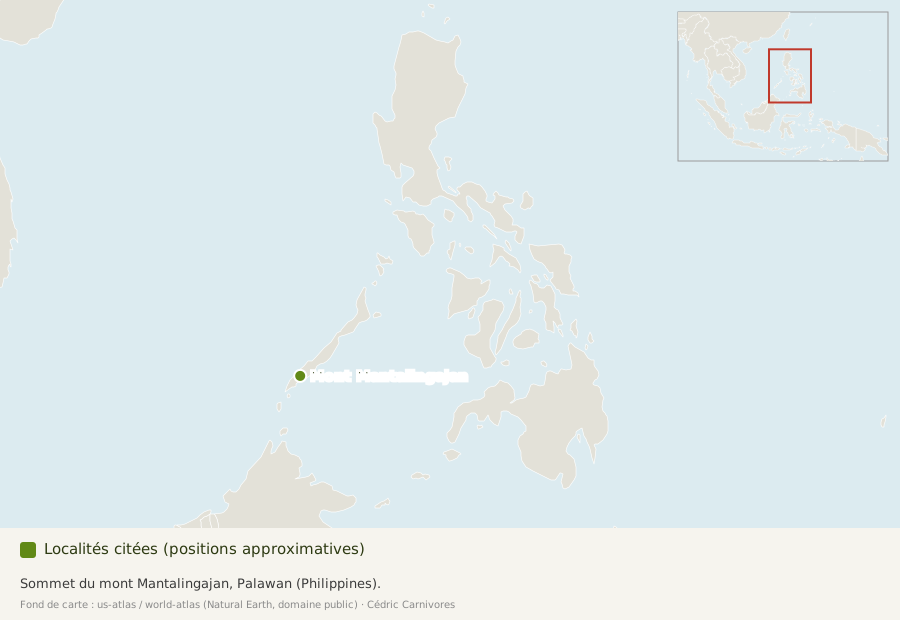
Endemic to Palawan: only the summit area of Mount Mantalingajan, from about 1,700 m to the summit (2,085 m).
Habitat
High-mountain forest and subalpine scrub; at the summit, stunted plants that often flower at less than 25 cm. Like its relatives, it is smothered by bamboo.
Threats and protection
Not threatened for now according to Stewart McPherson: extensive populations and a protected mountain.
Did you know?
- It belongs to the N. villosa complex, together with the Palawan species N. attenboroughii, N. deaniana, N. leonardoi and N. mira, and N. peltata from Mindanao; it is smaller, with narrower, pointed leaves.
Sources
- Wikipedia (English), Nepenthes mantalingajanensis: publication, etymology, history, description, range, altitude, habitat, status, relationships.