Nepenthes merrilliana Macfarl.
Species sheet, updated on 29/10/2026.
At a glance
| Scientific name | Nepenthes merrilliana John Muirhead Macfarlane, 1911 |
| Synonym | N. merrillii Elmer (1915, spelling mistake) |
| Family | Nepenthaceae |
| Distribution | Philippines: northern and central Mindanao, Dinagat and Samar |
| Habitat | Coastal forest on steep slopes, from sea level to 1,100 m |
| Status | Vulnerable (IUCN, 2000) |
Etymology
- Nepenthes: see the genus sheet.
- merrilliana: in honour of the American botanist Elmer Drew Merrill, a leading expert on the flora of the Philippines.
History of the description
- 1911: Macfarlane described it, in the same year as N. truncata.
- Several authors (Danser in 1928, Jebb and Cheek in 1997 and 2001) applied this name to plants now assigned to N. surigaoensis, which was long treated as a synonym.
Description (how to recognise it)
It bears some of the largest pitchers in the genus, comparable to those of N. rajah.
Distribution
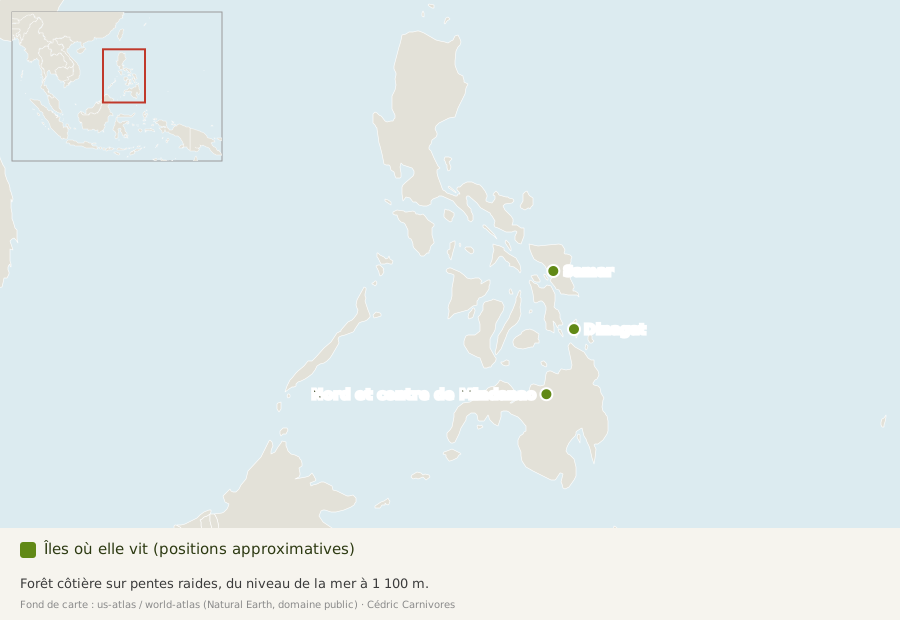
Endemic to the Philippines: northern and central Mindanao, Dinagat and Samar; its presence in southern Mindanao remains uncertain. From sea level to 1,100 m.
Habitat
Coastal forest, on steep slopes.
Relationships
Close relatives: N. surigaoensis and N. samar.
Natural hybrids
| Hybrid | Other parent(s) |
|---|---|
| N. × merrilliata | N. alata |
| N. × tsangoya (doubtful) | (N. alata × N. merrilliana) × N. mirabilis |
| unnamed | N. bellii, N. mindanaoensis, N. mirabilis |
Threats and protection
“Vulnerable” according to the IUCN (2000 assessment).
Sources
- Wikipedia (English), Nepenthes merrilliana: Macfarlane 1911, etymology, synonyms, misapplied names, pitcher size, range, altitude, habitat, relationships, hybrids, status.