Nepenthes micramphora V. B. Heinrich, S. McPherson, Gronem. & V. B. Amoroso
Species sheet, updated on 30/10/2026.
At a glance
| Scientific name | Nepenthes micramphora Volker Heinrich, Stewart McPherson, Thomas Gronemeyer & Victor B. Amoroso, Pitcher Plants of the Old World vol. 2, 2009 |
| Family | Nepenthaceae |
| Distribution | Mount Hamiguitan, Davao Oriental (Mindanao) |
| Habitat | Mossy forest, ridges, cliffs and screes on ultramafic rock, from 1,100 to 1,635 m |
Etymology
- Nepenthes: see the genus sheet.
- micramphora: from the Greek mikros, “small”, and the Latin amphora, “amphora”: for its tiny pitchers.
History of the description
- 31 January 2005: Victor B. Amoroso and R. Aspiras collected the type specimen on the San Isidro trail, between 1,300 and 1,600 m.
- 2009: description.
Description (how to recognise it)
- A slender climber up to 2.5 m, entirely hairless.
- Minute lower pitchers, up to 4 cm by 1.6.
- Upper pitchers up to 6.7 cm, usually around 4 cm.
- Branched spur, up to 3 mm.
Distribution
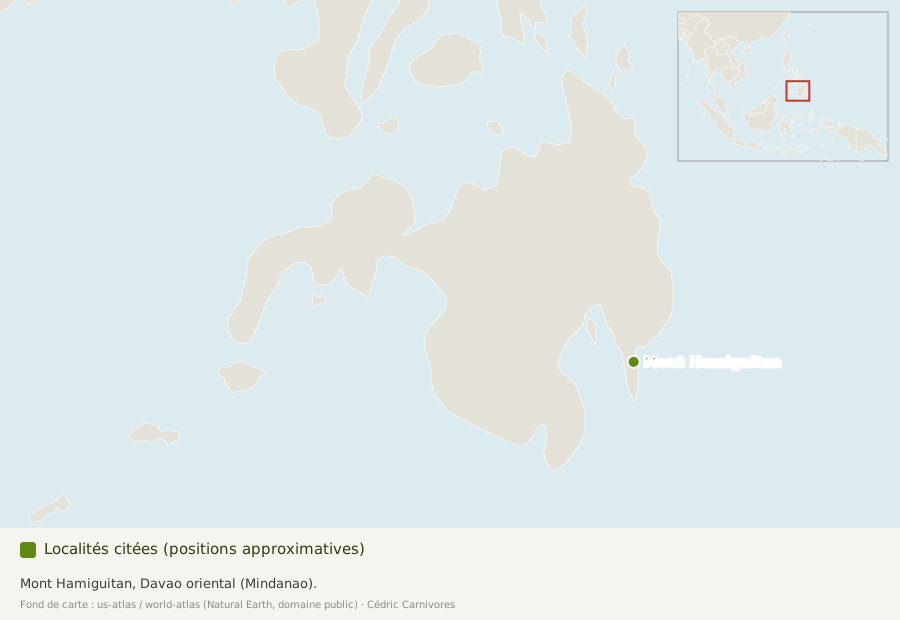
Endemic to Mindanao: Mount Hamiguitan (Davao Oriental), from 1,100 to 1,635 m.
Habitat
On the ground, in high-mountain mossy forest, secondary vegetation, on ridges, cliffs and landslides, on ultramafic rock. It tolerates shade but grows better in full sun.
Ecology
It grows near N. alata in the broad sense, N. justinae and N. peltata.
Natural hybrids
None confirmed; the plants once thought to be N. micramphora × N. peltata are now N. hamiguitanensis.
Threats and protection
Not threatened according to McPherson (2009): large populations, and the mountain can only be visited with a guide.
Did you know?
- It gives its name to the N. micramphora group, together with N. abgracilis and N. cid. It was first mistaken for N. bellii.
Sources
- Wikipedia (English), Nepenthes micramphora: publication, etymology, type specimen, description, range, altitude, habitat, neighbouring species, hybrids, threats, group.