Nepenthes mikei B. R. Salmon & Maulder
Species sheet, updated on 29/10/2026.
At a glance
| Scientific name | Nepenthes mikei Bruce Salmon & Ricky Maulder, Carnivorous Plant Newsletter, 1995 |
| Former horticultural name | “N. minutissima” |
| Family | Nepenthaceae |
| Distribution | Mount Pangulubao (North Sumatra) and Mount Bandahara (Aceh) |
| Habitat | Summit scrub and mossy forest, on the ground, from 1,100 to 2,800 m |
| Status | Vulnerable (IUCN, 2000) |
Photos in the wild
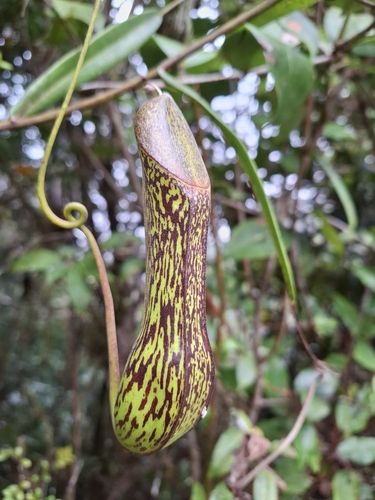
Etymology
- Nepenthes: see the genus sheet.
- mikei: in honour of Mike Hopkins, one of its discoverers.
History of the discovery
September 1989: Bruce Salmon, Mike Hopkins and Ricky Maulder found it on Mount Pangulubao. Growers first called it “N. minutissima”. Description in 1995; the reference specimen is held at the Auckland Museum (New Zealand).
Description (how to recognise it)
- A climber up to 7 m, which quickly moves from the rosette to the climbing stem.
- Leaves: narrow, up to 10 cm by 2.
- Lower pitchers: up to 12 cm by 3, dark and mottled.
- Upper pitchers: smaller, up to 8 cm.
- On the Bandahara, the plant produces offshoots from underground stems.
Distribution
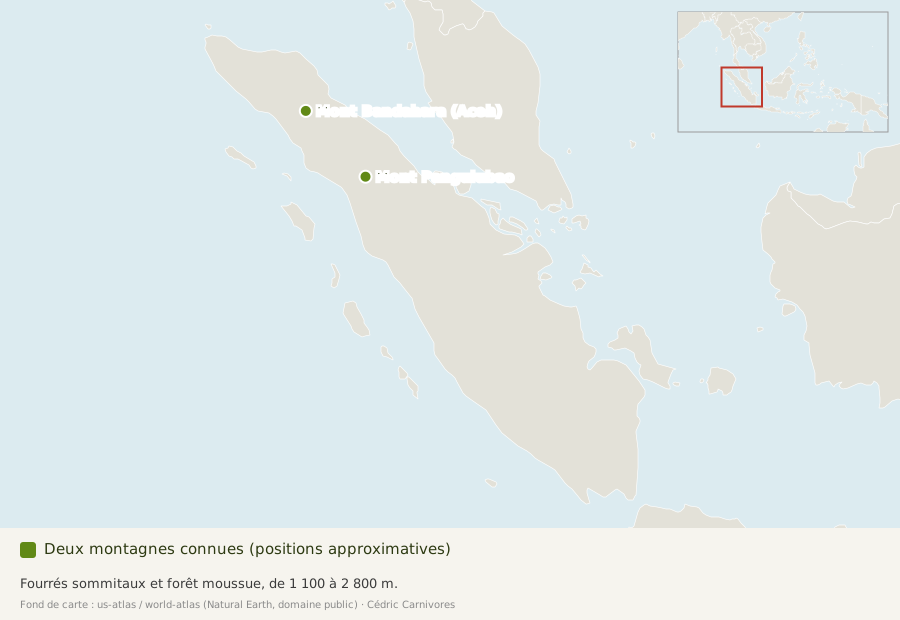
Endemic to Sumatra, known from two mountains: the Pangulubao (North Sumatra) and the Bandahara (Aceh). From 1,100 to 2,800 m.
Habitat
On the ground, in summit scrub and mossy forest, often in open, sunny places such as ridges.
Relationships
Very close to N. angasanensis, perhaps the same species.
Natural hybrids
Four: with N. diatas (on the Bandahara), N. gymnamphora (N. × pangulubauensis), N. ovata and N. spectabilis.
Threats and protection
“Vulnerable” according to the IUCN (2000): habitat loss and collecting.
Sources
- Wikipedia (English), Nepenthes mikei: Salmon & Maulder 1995, 1989 discovery, etymology, specimen, description, range, altitude, habitat, relationships, hybrids, status.
- Wikipedia (English), Nepenthes gymnamphora: N. × pangulubauensis.