Nepenthes mollis Danser
Species sheet, updated on 29/10/2026.
At a glance
| Scientific name | Nepenthes mollis B. H. Danser, 1928 |
| Common name | Velvet pitcher-plant; in French “népenthès de velours” |
| Recent synonym | N. hurrelliana Cheek & A. L. Lamb (2003), according to Robinson et al. (2019) |
| Family | Nepenthaceae |
| Distribution | Borneo: Mount Kemul (East Kalimantan); with hurrelliana, also northern Sarawak, Brunei and south-western Sabah |
| Habitat | Dense montane forest, at about 1,800 m on Mount Kemul |
| Status | Data deficient (IUCN) |
Etymology
- Nepenthes: see the genus sheet.
- mollis: from the Latin mollis, “soft”, for the dense hairs that cover the whole plant.
History: a species lost for almost a century
- 17 October 1925: the forester Frederik Endert collected it near the summit of Mount Kemul, at about 1,800 m, during an expedition of the Forest Research Institute of Buitenzorg (Bogor) to central Borneo. There he also collected N. fusca for the first time.
- 1928: Danser described it from this single specimen: a leafy stem and a male inflorescence. Neither its pitchers nor its female flowers were known.
- 1999: Bruce Salmon suggested that specimens from Mount Lumarku were N. mollis. They were described in 2003 as a new species, N. hurrelliana.
- It was one of the 25 “most wanted” lost species of the organisation Global Wildlife Conservation.
- 2019: an expedition to the Kemul massif rediscovered it at its original site. The study that followed (Robinson et al., Phytotaxa, 2019) concluded that N. hurrelliana* is the same species as *N. mollis.
Description (how to recognise it)
From the 1925 specimen:
- A climber at least 4 m long.
- Leaves: leathery, without a petiole, up to 20 cm by 4.5, with the base running down the stem as two wings.
- A fur coat: very dense brown hairs cover all parts, stems, leaves and young pitchers.
Distribution
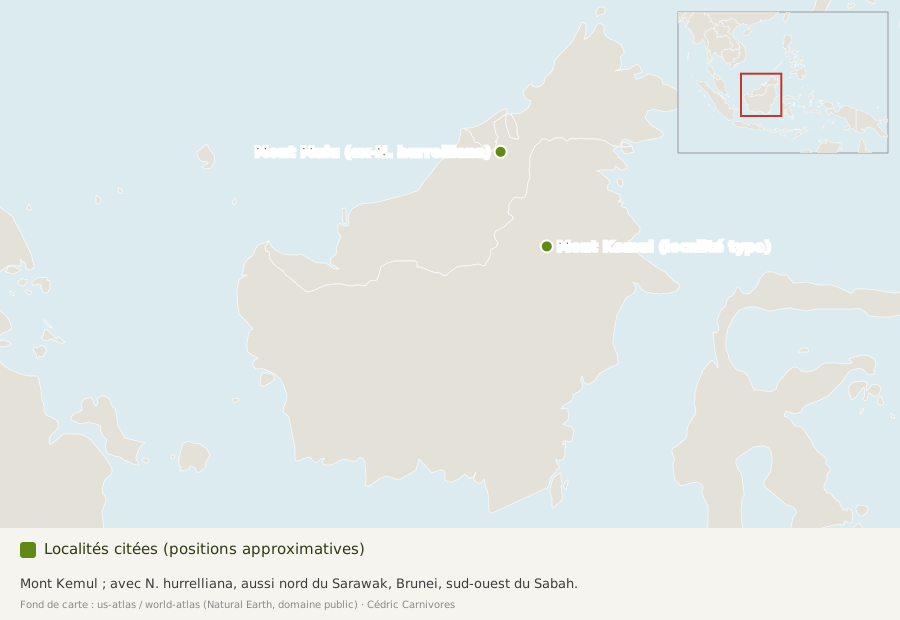
- Mount Kemul, in East Kalimantan (type locality).
- If N. hurrelliana is included: also northern Sarawak, Brunei and south-western Sabah. On Mount Mulu, hurrelliana grows above 1,500 m, above N. vogelii.
Habitat
On Mount Kemul, dense forest on a steep slope at about 1,800 m; perhaps also mossy forest (Clarke).
Relationships
Danser placed it in section Regiae. Clarke and Schlauer considered it close to N. hirsuta, which is also very hairy.
Natural hybrids
None known.
Threats and protection
“Data deficient” according to the IUCN, for lack of observations until 2019.
Sources
- Wikipedia (English), Nepenthes mollis: Danser 1928, Endert 1925, specimen, description, habitat, relationships, history of N. hurrelliana, list of lost species, status.
- Robinson et al. 2019, Phytotaxa 392(2) (abstract): rediscovery on the Kemul, N. hurrelliana a synonym of N. mollis.
- Wikipedia (English), Nepenthes vogelii: N. hurrelliana above 1,500 m on the Mulu.